The following story was in the New York Post in the Page Six section:
March 6, 2007 -- RACHAEL Ray was attacked by a dog in Union Square Park Saturday while bravely defending her pit-bull mix, Isaboo. According to the TV host's rep, "This dog came up - there was no owner in sight - and became aggressive. Rachael and some others shooed it away, but it came back and attacked Isaboo. Other dogs were involved, and Rachael jumped in and was bit by one of the dogs on the leg. A nurse was in the park and checked her out. She's fine."
I wonder where the owner was? Oh, that doesn't matter, it was during the offleash hours.
The article link is here.
Friday, March 09, 2007
Dog on dog attack
I just received the following from a friend in Prospect Park:
Sent: Fri, 9 Mar 2007 5:16 PM
Subject: dog attack
[ ... ] My neighbor Angela was walking her small collie (a miniture, or Sheltie) in the park last weekend, on a leash. She was talking to a woman whose large Shepherd was off-leash. It suddenly attacked her dog, with the owner just flailing around, Angela screaming and kicking the dog, and her little dog getting ripped apart. Suddenly (she said like a guardian angel) Steve was on the attack dog, grabbed it by the hackles and pulled it off. The owner of the vicious dog is now pissed at Angela for "bad mouthing" her with the FIDO crowd. Angela told her if she ever sees her with that dog off leash again, she'll call the cops. Here's the interesting part. Angela said this woman is an "ex-nun." I knew immediately who she was talking about. This same woman used to have 3 large out of control shepherds (I think one of them was the one who attacked Peter). When I used to take my dog to the park about 8 years ago, everyone knew her dogs were vicious and out of control. She's still around, and still out of control. The vet told Angela [that] Steve saved her dog's life. The dog is full of puncture wounds that are getting inflamed and infected, and the bills will be considerable).
I'm looking for "reporters" from other parks around Brooklyn and the city. If you, or anyone you know, frequents a park other than Central Park and Prospect Park and has had problems with unleashed dogs, write to me here:

Sent: Fri, 9 Mar 2007 5:16 PM
Subject: dog attack
[ ... ] My neighbor Angela was walking her small collie (a miniture, or Sheltie) in the park last weekend, on a leash. She was talking to a woman whose large Shepherd was off-leash. It suddenly attacked her dog, with the owner just flailing around, Angela screaming and kicking the dog, and her little dog getting ripped apart. Suddenly (she said like a guardian angel) Steve was on the attack dog, grabbed it by the hackles and pulled it off. The owner of the vicious dog is now pissed at Angela for "bad mouthing" her with the FIDO crowd. Angela told her if she ever sees her with that dog off leash again, she'll call the cops. Here's the interesting part. Angela said this woman is an "ex-nun." I knew immediately who she was talking about. This same woman used to have 3 large out of control shepherds (I think one of them was the one who attacked Peter). When I used to take my dog to the park about 8 years ago, everyone knew her dogs were vicious and out of control. She's still around, and still out of control. The vet told Angela [that] Steve saved her dog's life. The dog is full of puncture wounds that are getting inflamed and infected, and the bills will be considerable).
I'm looking for "reporters" from other parks around Brooklyn and the city. If you, or anyone you know, frequents a park other than Central Park and Prospect Park and has had problems with unleashed dogs, write to me here:

Friday, March 02, 2007
Brooklyn Record comments
The Brooklyn Record posted a story about my "Pepper Spray" posting. What followed was a steady stream of comments, some of which are clearly representative of the offleash lunative fringe's character and temperment. I'm not sure what motivated the Brooklyn Record editor, but the entire piece was recently removed from the website. I was able to download a cached version and save it to a PDF file. You can read the text here:
-Brooklyn Record, "Fighting off Dogs with Pepper Spray"-
I also don't know why the following comments was removed from the list of comments. Draw you own conclusions:
"At the public hearing the other day, where were the minorities? Absent were the blacks, Hispanics, Asians, Hasids, Middle Easterners and other minorities. Present were whites only. So, is this offleash fury all about parks for whites only? Just noticing. Just asking. I was the tall guy up front watching the show, taking notes."
-Brooklyn Record, "Fighting off Dogs with Pepper Spray"-
I also don't know why the following comments was removed from the list of comments. Draw you own conclusions:
"At the public hearing the other day, where were the minorities? Absent were the blacks, Hispanics, Asians, Hasids, Middle Easterners and other minorities. Present were whites only. So, is this offleash fury all about parks for whites only? Just noticing. Just asking. I was the tall guy up front watching the show, taking notes."
Column in the NY Daily News
The following was in yesterday's New York Daily News:
New York Daily News, Originally published on March 1, 2007
It's much a-'doo' about droppings
by Denis Hamill
Talk about kicking up a stink.
Last week, I wrote here about being forced out of Crocheron Park twice because of a plethora of dog crap on the meadows and ball fields. I complained that this was probably a direct result of the insane new law permitting dogs to run free through our city parks from 9 p.m. to 9 a.m.
I'm actually happy for the poor dogs that are forced to live in a cramped city of 8 million people. After being imprisoned in small apartments, sometimes chained in basements or on back porches, the poor animals need to answer the call of the wild. They need to run free. And when they do, they usually relieve themselves.
The problem is that some of the selfish dog owners don't clean up after them.
Don't blame the poor dogs. Blame the dirty people.
Because when a father like me takes his little kid to the park to toss around a football, as I did on two different occasions recently, my son stepped in dog poop.
Once, the ball rolled in it. Both times I had to take my kid home from a public park created for people because of the droppings of domesticated animals.
That, in a word, stinks.
I wrote a column knocking irresponsible dog owners. Not dogs. And the spit hit the fan. Everyone in this business knows that you can write about war, pedophilia, rape, murder, racism, nuclear brinksmanship, political corruption, terrorism and even Britney Spears' haircut and you will get a feisty but civilized discourse with intelligent readers.
But write about dog crap and you get more mail than Santa Claus, and very little of it nice. Or sane.
Someone at the Daily News told me a story about when a reporter and a photographer flew to South America some 20-odd years ago to cover a mammoth mudslide caused by a volcanic eruption.
Entire villages were buried in mud and rubble. Thousands of people died. The team filed wrenching stories and heartbreaking photos detailing every conceivable permutation of human misery. Families lost. Children buried. Wailing mothers.
The response from readers was sad but measured.
Then photographer John Roca snapped a photo of a dog wandering alone in the mud and the reporter filed a story about the animals affected by the earthquake and the phones at the city desk lit up like the Manhattan skyline. Stop the presses!
My mail last week steamed with hate. Muffet Jones wrote, ". . .Your rant against dogs in parks is circulating [on] the Internet. You are a very poor writer and it's doubly unfortunate that you have reproduced." Gary Kaskel also attacked my kid, "Sorry your yuppie spawn got dog doody on him. Let's all call the Centers for Disease Control!"
"Spawn" I'll take on the chin. But "yuppie" is a bitin' word!
Someone else suggested if I didn't like dogs in the city parks, I should move to North Dakota.
Huh? I was certain this was a gag campaign orchestrated by some new comedy team with a name like Dung and Dunger.
But these people were dead serious.
I also received many letters agreeing with me and a polite note from Parks Department spokesman Warner Johnston who said he'd read my column and that they'd inspected the lawns of Crocheron Park for K-9 waste and couldn't find any, "although we did find a lot of goose droppings."
This unscientific, bureaucratic CYA comment soon ricocheted around the dogosphere and was swallowed as dogma.
Soon everyone with an incontinent pooch and a computer mouse was an accredited dungologist and e-mailing me, insisting my kid stepped in goose goop and that I was a dog hater. Which I'm not.
One editor e-mailed me that his divorce lawyer, "a dog owner who uses Prospect Park, just called me full of good cheer to say that the Parks Department confirmed that the poop you wrote about was from Canadian geese."
The Parks Dept. confirmed nothing! They have no idea what my kid stepped in. I do. (Excuse the pun.)
But now Dogland Security has even ID'ed the nationality of the poop perps! The rabid right-wingers were right about that porous Canadian border!
Look, I worked on a farm in Ireland as a teenager, driving cattle to and from pasture with a magnificent cattle dog, and later cleaning the waste out of the dairy, horse barn, chicken coops.
I grew up on the top floor of a Brooklyn tenement where Babe Caputo kept a pigeon coop on the roof and so I know from stinking experience about animal droppings.
Even when droppings come from a large goose, and factoring in that they turn from green to brown with age, they do not remotely resemble hound mounds.
And I have covered enough political campaigns in my career to differentiate between the by-products of bulls, horses, dogs and geese. What my kid stepped in at Crocheron Park, twice, was dog crap.
No B.S.
New York Daily News, Originally published on March 1, 2007
It's much a-'doo' about droppings
by Denis Hamill
Talk about kicking up a stink.
Last week, I wrote here about being forced out of Crocheron Park twice because of a plethora of dog crap on the meadows and ball fields. I complained that this was probably a direct result of the insane new law permitting dogs to run free through our city parks from 9 p.m. to 9 a.m.
I'm actually happy for the poor dogs that are forced to live in a cramped city of 8 million people. After being imprisoned in small apartments, sometimes chained in basements or on back porches, the poor animals need to answer the call of the wild. They need to run free. And when they do, they usually relieve themselves.
The problem is that some of the selfish dog owners don't clean up after them.
Don't blame the poor dogs. Blame the dirty people.
Because when a father like me takes his little kid to the park to toss around a football, as I did on two different occasions recently, my son stepped in dog poop.
Once, the ball rolled in it. Both times I had to take my kid home from a public park created for people because of the droppings of domesticated animals.
That, in a word, stinks.
I wrote a column knocking irresponsible dog owners. Not dogs. And the spit hit the fan. Everyone in this business knows that you can write about war, pedophilia, rape, murder, racism, nuclear brinksmanship, political corruption, terrorism and even Britney Spears' haircut and you will get a feisty but civilized discourse with intelligent readers.
But write about dog crap and you get more mail than Santa Claus, and very little of it nice. Or sane.
Someone at the Daily News told me a story about when a reporter and a photographer flew to South America some 20-odd years ago to cover a mammoth mudslide caused by a volcanic eruption.
Entire villages were buried in mud and rubble. Thousands of people died. The team filed wrenching stories and heartbreaking photos detailing every conceivable permutation of human misery. Families lost. Children buried. Wailing mothers.
The response from readers was sad but measured.
Then photographer John Roca snapped a photo of a dog wandering alone in the mud and the reporter filed a story about the animals affected by the earthquake and the phones at the city desk lit up like the Manhattan skyline. Stop the presses!
My mail last week steamed with hate. Muffet Jones wrote, ". . .Your rant against dogs in parks is circulating [on] the Internet. You are a very poor writer and it's doubly unfortunate that you have reproduced." Gary Kaskel also attacked my kid, "Sorry your yuppie spawn got dog doody on him. Let's all call the Centers for Disease Control!"
"Spawn" I'll take on the chin. But "yuppie" is a bitin' word!
Someone else suggested if I didn't like dogs in the city parks, I should move to North Dakota.
Huh? I was certain this was a gag campaign orchestrated by some new comedy team with a name like Dung and Dunger.
But these people were dead serious.
I also received many letters agreeing with me and a polite note from Parks Department spokesman Warner Johnston who said he'd read my column and that they'd inspected the lawns of Crocheron Park for K-9 waste and couldn't find any, "although we did find a lot of goose droppings."
This unscientific, bureaucratic CYA comment soon ricocheted around the dogosphere and was swallowed as dogma.
Soon everyone with an incontinent pooch and a computer mouse was an accredited dungologist and e-mailing me, insisting my kid stepped in goose goop and that I was a dog hater. Which I'm not.
One editor e-mailed me that his divorce lawyer, "a dog owner who uses Prospect Park, just called me full of good cheer to say that the Parks Department confirmed that the poop you wrote about was from Canadian geese."
The Parks Dept. confirmed nothing! They have no idea what my kid stepped in. I do. (Excuse the pun.)
But now Dogland Security has even ID'ed the nationality of the poop perps! The rabid right-wingers were right about that porous Canadian border!
Look, I worked on a farm in Ireland as a teenager, driving cattle to and from pasture with a magnificent cattle dog, and later cleaning the waste out of the dairy, horse barn, chicken coops.
I grew up on the top floor of a Brooklyn tenement where Babe Caputo kept a pigeon coop on the roof and so I know from stinking experience about animal droppings.
Even when droppings come from a large goose, and factoring in that they turn from green to brown with age, they do not remotely resemble hound mounds.
And I have covered enough political campaigns in my career to differentiate between the by-products of bulls, horses, dogs and geese. What my kid stepped in at Crocheron Park, twice, was dog crap.
No B.S.
Thursday, March 01, 2007
"Certain Times and Places"
Both Henry Stern and current commissioner of parks, Adrien Benepe, use vague terms, such as, "certain times and places" to describe the unofficial off-leash policy. It appears that only the offleash, lunatic fringe know the details of the where and when. It is for that reason that I issue a challenge to Robert A. Marino of N.Y.C.D.O.G. Post on the N.Y.C.D.O.G. website and distribute as a press release the times and places where the alleged 20 year policy has taken place and "needs" to be made official. Make sure that, when it comes to Prospect Park, that the general public understands the following:
- The offleash areas encompass nearly 110 acres
- The offleash areas cover nearly every open field and meadow
- The offleash hours begin at 5pm for half the year
- The offleash hours begin at 9pm for the other half of the year
Since Mr. Marino makes the claim that it has been such a success, he must know the details of each park that has benefited from the "unofficial policy". Make sure that the all times and places are listed for the following parks. I'm sure that some of the 20,000 or 33,000 members (it depends on which press release you read) would be happy to help you put the list together:
Bronx:
Bronx Park
Crotona Park
Henry Hudson Park
Julius Richman Park (formerly Echo Park)
Pelham Bay Park
University Woods
Van Cortlandt Park
Brooklyn:
Carroll Park
Empire-Fulton Ferry State Park
Fort Greene Park
Marine Park
Prospect Park
Sunset Park
McCarren Park
McGolrick Park
Owl's Head Park
Manhattan:
Battery Park
Bennett Park
Bowling Green
Bryant Park
Carl Schurz Park
Central Park
City Hall Park
Collect Pond Park
Columbus Park
Damrosch Park (Lincoln Center)
Dante Park
DeWitt Clinton Park
East River Park
Fort Tryon Park
Fort Washington Park
Gramercy Park
High Line
Highbridge Park
Hudson River Park
Inwood Hill Park
J. Hood Wright Park
John Jay Park
Madison Square Park
Marcus Garvey Memorial Park
Morningside Park
Paley Park
Ralph Bunche Park
Randalls Island-Ward's Island
Riverbank State Park
Riverside Park
Sakura Park
Samuel N. Bennerson 2nd Playground
Sara Delano Roosevelt Park
St. Nicholas Park
Straus Park
Stuyvesant Park
Thomas Paine Park
Tompkins Square Park
Union Square
Washington Square Park
Winston Churchill Park
Queens:
Alley Pond Park
Astoria Park
Baisley Pond Park
Brookville Park
Clearview Park
Cunningham Park
Doughboy Park
Flushing Meadows-Corona Park
Forest Park
Frank Golden Memorial Park
Juniper Valley Park
Kissena Park
Liberty Park
Major Mark Park
Maurice Park
Roy Wilkens Park
Rainy Park
Rufus King Park
Springfield Park
Staten Island:
Amundsen Circle
Austen House Park
Bradys Park
Blue Heron Park Preserve
Conference House Park
Clove Lakes Park
Franklin D. Roosevelt Boardwalk
Fresh Kills Park
Lemon Park
Silver Lake Park
The Greenbelt
Willowbrook Park
Wolfe's Pond Park
- The offleash areas encompass nearly 110 acres
- The offleash areas cover nearly every open field and meadow
- The offleash hours begin at 5pm for half the year
- The offleash hours begin at 9pm for the other half of the year
Since Mr. Marino makes the claim that it has been such a success, he must know the details of each park that has benefited from the "unofficial policy". Make sure that the all times and places are listed for the following parks. I'm sure that some of the 20,000 or 33,000 members (it depends on which press release you read) would be happy to help you put the list together:
Bronx:
Bronx Park
Crotona Park
Henry Hudson Park
Julius Richman Park (formerly Echo Park)
Pelham Bay Park
University Woods
Van Cortlandt Park
Brooklyn:
Carroll Park
Empire-Fulton Ferry State Park
Fort Greene Park
Marine Park
Prospect Park
Sunset Park
McCarren Park
McGolrick Park
Owl's Head Park
Manhattan:
Battery Park
Bennett Park
Bowling Green
Bryant Park
Carl Schurz Park
Central Park
City Hall Park
Collect Pond Park
Columbus Park
Damrosch Park (Lincoln Center)
Dante Park
DeWitt Clinton Park
East River Park
Fort Tryon Park
Fort Washington Park
Gramercy Park
High Line
Highbridge Park
Hudson River Park
Inwood Hill Park
J. Hood Wright Park
John Jay Park
Madison Square Park
Marcus Garvey Memorial Park
Morningside Park
Paley Park
Ralph Bunche Park
Randalls Island-Ward's Island
Riverbank State Park
Riverside Park
Sakura Park
Samuel N. Bennerson 2nd Playground
Sara Delano Roosevelt Park
St. Nicholas Park
Straus Park
Stuyvesant Park
Thomas Paine Park
Tompkins Square Park
Union Square
Washington Square Park
Winston Churchill Park
Queens:
Alley Pond Park
Astoria Park
Baisley Pond Park
Brookville Park
Clearview Park
Cunningham Park
Doughboy Park
Flushing Meadows-Corona Park
Forest Park
Frank Golden Memorial Park
Juniper Valley Park
Kissena Park
Liberty Park
Major Mark Park
Maurice Park
Roy Wilkens Park
Rainy Park
Rufus King Park
Springfield Park
Staten Island:
Amundsen Circle
Austen House Park
Bradys Park
Blue Heron Park Preserve
Conference House Park
Clove Lakes Park
Franklin D. Roosevelt Boardwalk
Fresh Kills Park
Lemon Park
Silver Lake Park
The Greenbelt
Willowbrook Park
Wolfe's Pond Park
Thursday, February 22, 2007
Reasons to be Fearful
I'd like to thank Robert A. Marino for providing me with such a comprehensive list of reasons why dogs should NEVER be allowed to run unleashed in unenclosed areas of New York City parks. The following list of instructions is posted on his website. At the end of this posting is a map of Prospect Park with the offleash areas highlighted. The 90 acre Long Meadow is claimed to be the largest meadow in any U.S. park, and what better way to treat it. Keep in mind that there are no double-gates, fencing or anyway to prevent parents from pushing their strollers through the "dog park" unless they remain outside of Prospect Park for the 16 hours each day that are set aside to unleashed dogs.
Someone needs to point out to Bobby boy that he can't have it both ways; either unleashed dogs ARE a danger to the public or they AREN'T a danger to the public.
Dog Park Etiquette
In order that everyone enjoys their time in the dog park we ask that you respect the rules of the park and be considerate of your fellow dog guardians.
* Open and Close One Safety Gate at a Time when entering the park. Dogs love to meet and greet newcomers. Please pay special attention when entering and exiting so no dog has a chance to run out.
* Unleash your dog within the safety gates before releasing your dog into the dog park. A leashed dog can excite problem dogs into aggression. Dogs can also be more aggressive when leashed due to the loss of control over their environment. They may feel frustrated, anxious and or threatened and since they can’t do what they instinctually do (flee or fight) to protect themselves and/or their owners they do what they can, they bark and lunge. It is safer to leash your dog up within the safety gates and not in the dog park itself.
* Stay conscious of the environment. Using headphones in the dog park is not a good idea.
* Keep an eye on your dog. Always keep your dog in view and under control. Be especially aware of your dog when children are near.
*No aggressive dogs. At the first sign of aggression please remove your dog from the dog park. When a dog park is open to all (non-membership) we and our dogs could be vulnerable to dogs that don’t know their physical boundaries. The dog that knows good physical boundaries can play without shoving the other dog. There is a difference between rough play and fighting. Dogs at play often mouth, jump on and/or nip each other. It can look like fighting, but no blood is drawn and the biting is inhibited as it doesn't break the skin. A dog in play will play without accentuated or obsessive physical contact. If your dog begins to get aroused divert his/her attention before it escalates and if necessary leave the dog park.
* Know the signs of aggression. Although difficult to define on certain breeds, the conflicted or overly confident dogs’ ears are usually up and/or forward. They face and stare directly at the other dog or human with whom they are interacting. Eye contact is sustained hard and direct. Their brow is furrowed. The tail carriage is likely to be high up and arched over the rump. The (hackles) fur along their back stands up like a ridge and the chest and stance is forward. Dogs with shorter tails might be straight and wagging stiffly.
* If a fight breaks out, all involved dog owners should immediately help break it up.
** First and foremost – Please try and remain calm and never put a body part between the fighting dogs. Here are some suggestions: Ask the steward at your dog park to provide a container that could permanently hold some blankets, water bottles, horns, whistles etc. so you will always have an aversive handy.
At the first sign of a fight take one of the items from the container and get as close to the fighting dogs as possible without endangering yourself and either:
- bang 2 large garbage can covers together like cymbals
- spray water bottle
- grab a blanket, shirt and/or jacket and throw it over the dogs and when they separate take your dog and leave the dog park.
- use the water hose in the summer
- For the experienced guardian only- take your dog by its hindquarters – just below the rump – and raise them up like you are holding a wheelbarrow and start backing up slowly as you pull the dog with you. Be very careful as you pull because if one dog has another by a body part and decides to hold on you risk tearing the skin.
Once the dogs have separated themselves take yours away.
- If you suspect damage has been done to you or your dog exchange vital information with all involved parties as you leave to get vet care.
*If your dog consistently harasses other dogs or people by intimidating, mounting, or annoying another dog, correct that behavior immediately. If it continues please take your dog out of the dog park at least for a short time out.
* Closely supervise intact males. If your intact male is involved in any altercation, regardless of which dog started it, please leave. (Intact males commonly provoke aggression.)
* No dogs in heat in the dog park. Since most females go into heat only 2x a year and are considered to be “in heat” for 21 days (7 days going in, 7 days in heat and 7 days going out), it is advisable not to bring them to a dog run during this time. Male dogs can sense females in heat through pheromones. These are airborne chemical attractants that are liberated from the female when she is cycling. They travel through the air for great distances.
* Teach your dog to be quiet. Some barking is fine, expected and normal. However incessant barking can be annoying to those around you. Try and find creative ways to discourage barking by changing your dogs focus towards something more fun, like a game of chase and interaction with you.
* During slow hours please limit your stay to 20 minutes if another dog owner is waiting to use the dog park. Dog owners who have dogs with behavior problems will often bring them late at night or very early in the morning, when the dog park is likely to be empty. (These dogs need to be exercised also.) Always ask if it is safe to join another dog if it is the only dog in the dog park.
DO’S AND DON’TS
* No prong, spiked collars or choke chains in the dog park. The ring ends can get caught on other objects as well as other dogs’ collars. Leave on your dog's regular collar with ID and license while in the park.
* Do not bring rawhides and toys to the dog park. Many dogs are so crazy for rawhides and toys that they will fight over them. (This does not apply to special events.)
* The small blue balls for playing handball are dangerous for medium and large dogs as they can easily get lodged in their throat. If you bring a handball or any small ball to the dog park and a larger dog is interested in playing, please refrain from using them and be sure to take them with you when you leave.
* Don't bring dogs that are ill into the dog park.
* Shared water bowls can cause dogs to get sick if one of the dogs drinking from the bowl is sick. Refresh the water bowl as often as possible or bring your own water bowl.
* Put dog hair in a trash can if you groom your dog in the dog park.
* No glass containers in the dog park.
* Pick up after your dog. Alert others if they miss a pick up.
ATTENTION PARENTS
* Bring your children into the dog park at their/your own risk. However we recommend that children under 8 years of age not be permitted in the dog park but if you choose to please, for their safety, keep children under your supervision and within arms reach at all times.
* CHILDREN SHOULD NOT BE BROUGHT INTO THE DOG PARK IN STROLLERS!
* KEEP BABIES AND TODDLERS OUT OF THE REACH OF DOGS! Dangling feet are stimulating to dogs. They may jump up as if playing with a toy.
PLEASE EDUCATE CHILDREN ON SMART BEHAVIOR AROUND DOGS:
1. Do not run or scream in the dog park. (Running and screaming are invitations for dogs to chase.)
2. Do not touch or take a dog's ball without speaking to the owner first.
3. Ask an adult before petting an unfamiliar dog. All dogs are potential biters no matter what size. Just because a dog is small it does not mean he is safe and can’t do damage. Wait for the dog to approach you instead of offering your hand.
4. Do not touch dogs while they are resting or sleeping, especially if they are under a bench.
5. Do not hug or kiss dogs that are not your own, however friendly they may seem.
6. Avoid rough play with dogs or other children while in the dog park.
7. If a dog growls at you, avoid eye contact by looking immediately away. Do not run away. Instead, back slowly away, continuing to avoid eye contact. If you have something in your pocket like a ball toss it to distract the dog as you continue to back away.
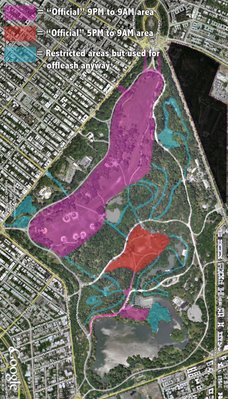
Someone needs to point out to Bobby boy that he can't have it both ways; either unleashed dogs ARE a danger to the public or they AREN'T a danger to the public.
Dog Park Etiquette
In order that everyone enjoys their time in the dog park we ask that you respect the rules of the park and be considerate of your fellow dog guardians.
* Open and Close One Safety Gate at a Time when entering the park. Dogs love to meet and greet newcomers. Please pay special attention when entering and exiting so no dog has a chance to run out.
* Unleash your dog within the safety gates before releasing your dog into the dog park. A leashed dog can excite problem dogs into aggression. Dogs can also be more aggressive when leashed due to the loss of control over their environment. They may feel frustrated, anxious and or threatened and since they can’t do what they instinctually do (flee or fight) to protect themselves and/or their owners they do what they can, they bark and lunge. It is safer to leash your dog up within the safety gates and not in the dog park itself.
* Stay conscious of the environment. Using headphones in the dog park is not a good idea.
* Keep an eye on your dog. Always keep your dog in view and under control. Be especially aware of your dog when children are near.
*No aggressive dogs. At the first sign of aggression please remove your dog from the dog park. When a dog park is open to all (non-membership) we and our dogs could be vulnerable to dogs that don’t know their physical boundaries. The dog that knows good physical boundaries can play without shoving the other dog. There is a difference between rough play and fighting. Dogs at play often mouth, jump on and/or nip each other. It can look like fighting, but no blood is drawn and the biting is inhibited as it doesn't break the skin. A dog in play will play without accentuated or obsessive physical contact. If your dog begins to get aroused divert his/her attention before it escalates and if necessary leave the dog park.
* Know the signs of aggression. Although difficult to define on certain breeds, the conflicted or overly confident dogs’ ears are usually up and/or forward. They face and stare directly at the other dog or human with whom they are interacting. Eye contact is sustained hard and direct. Their brow is furrowed. The tail carriage is likely to be high up and arched over the rump. The (hackles) fur along their back stands up like a ridge and the chest and stance is forward. Dogs with shorter tails might be straight and wagging stiffly.
* If a fight breaks out, all involved dog owners should immediately help break it up.
** First and foremost – Please try and remain calm and never put a body part between the fighting dogs. Here are some suggestions: Ask the steward at your dog park to provide a container that could permanently hold some blankets, water bottles, horns, whistles etc. so you will always have an aversive handy.
At the first sign of a fight take one of the items from the container and get as close to the fighting dogs as possible without endangering yourself and either:
- bang 2 large garbage can covers together like cymbals
- spray water bottle
- grab a blanket, shirt and/or jacket and throw it over the dogs and when they separate take your dog and leave the dog park.
- use the water hose in the summer
- For the experienced guardian only- take your dog by its hindquarters – just below the rump – and raise them up like you are holding a wheelbarrow and start backing up slowly as you pull the dog with you. Be very careful as you pull because if one dog has another by a body part and decides to hold on you risk tearing the skin.
Once the dogs have separated themselves take yours away.
- If you suspect damage has been done to you or your dog exchange vital information with all involved parties as you leave to get vet care.
*If your dog consistently harasses other dogs or people by intimidating, mounting, or annoying another dog, correct that behavior immediately. If it continues please take your dog out of the dog park at least for a short time out.
* Closely supervise intact males. If your intact male is involved in any altercation, regardless of which dog started it, please leave. (Intact males commonly provoke aggression.)
* No dogs in heat in the dog park. Since most females go into heat only 2x a year and are considered to be “in heat” for 21 days (7 days going in, 7 days in heat and 7 days going out), it is advisable not to bring them to a dog run during this time. Male dogs can sense females in heat through pheromones. These are airborne chemical attractants that are liberated from the female when she is cycling. They travel through the air for great distances.
* Teach your dog to be quiet. Some barking is fine, expected and normal. However incessant barking can be annoying to those around you. Try and find creative ways to discourage barking by changing your dogs focus towards something more fun, like a game of chase and interaction with you.
* During slow hours please limit your stay to 20 minutes if another dog owner is waiting to use the dog park. Dog owners who have dogs with behavior problems will often bring them late at night or very early in the morning, when the dog park is likely to be empty. (These dogs need to be exercised also.) Always ask if it is safe to join another dog if it is the only dog in the dog park.
DO’S AND DON’TS
* No prong, spiked collars or choke chains in the dog park. The ring ends can get caught on other objects as well as other dogs’ collars. Leave on your dog's regular collar with ID and license while in the park.
* Do not bring rawhides and toys to the dog park. Many dogs are so crazy for rawhides and toys that they will fight over them. (This does not apply to special events.)
* The small blue balls for playing handball are dangerous for medium and large dogs as they can easily get lodged in their throat. If you bring a handball or any small ball to the dog park and a larger dog is interested in playing, please refrain from using them and be sure to take them with you when you leave.
* Don't bring dogs that are ill into the dog park.
* Shared water bowls can cause dogs to get sick if one of the dogs drinking from the bowl is sick. Refresh the water bowl as often as possible or bring your own water bowl.
* Put dog hair in a trash can if you groom your dog in the dog park.
* No glass containers in the dog park.
* Pick up after your dog. Alert others if they miss a pick up.
ATTENTION PARENTS
* Bring your children into the dog park at their/your own risk. However we recommend that children under 8 years of age not be permitted in the dog park but if you choose to please, for their safety, keep children under your supervision and within arms reach at all times.
* CHILDREN SHOULD NOT BE BROUGHT INTO THE DOG PARK IN STROLLERS!
* KEEP BABIES AND TODDLERS OUT OF THE REACH OF DOGS! Dangling feet are stimulating to dogs. They may jump up as if playing with a toy.
PLEASE EDUCATE CHILDREN ON SMART BEHAVIOR AROUND DOGS:
1. Do not run or scream in the dog park. (Running and screaming are invitations for dogs to chase.)
2. Do not touch or take a dog's ball without speaking to the owner first.
3. Ask an adult before petting an unfamiliar dog. All dogs are potential biters no matter what size. Just because a dog is small it does not mean he is safe and can’t do damage. Wait for the dog to approach you instead of offering your hand.
4. Do not touch dogs while they are resting or sleeping, especially if they are under a bench.
5. Do not hug or kiss dogs that are not your own, however friendly they may seem.
6. Avoid rough play with dogs or other children while in the dog park.
7. If a dog growls at you, avoid eye contact by looking immediately away. Do not run away. Instead, back slowly away, continuing to avoid eye contact. If you have something in your pocket like a ball toss it to distract the dog as you continue to back away.

Tuesday, February 20, 2007
Fact and ficition
So, let's see if I can summarize the offleash lunatic fringe arguments for opening the parks to unleashed dogs.
"It has been a successful 20 year experiment"
- Documents posted on this blog have former park commissioner Henry Stern declaring that in 1999 they had to make a concerted effort to crack down on the dog problem. His efffort was applauded by the AKC.
- Current commissioner Adrian Benepe, in an article in New York Magazine in 1998 stated, "Ten to fifteen years ago, observes Adrian Benepe, the no-nonsense Parks commissioner for Manhattan, the parks were rife with crises: crime, drug dealing, graffiti, homeless encampments, rotting infrastructure. Many were resolved. “The dog problem is the only real problem we have,” he says. [...] “People are almost compelled to let them off the leash, because they need so much more exercise and space,” says Benepe. Dog owners make these choices and then expect their fellow New Yorkers to live with the consequences. “They say to us, ‘You need to allow us to exercise hunting dogs in crowded nineteenth-century parks.’ “
"Unleashed dogs have reduced crime in parks"
- We learned that, until last year, the NYPD did not keep separate statistics on crimes in parks. The information just doesn't exist to make their claim
- Crime began going down in NYC in 1991 as a directly result of new procedures under the Giuliani administration
"Socialized dogs are happier and healthier"
- By nearly all trainer's definition, socialized refers to people, places and things, not other dogs
- The title "animal behaviorist", or similar titles can be used by anyone, regardless of their background
- No ABS Certified Applied Animal Behaviorists thinks that allowing large groups of dogs to interact in an unenclosed environment is a positive decision
"Allowing thousands of dogs to run, unleashed in city parks has reduced dog bites"
- More like, all the unleashed dogs have chased more people out of the parks
- How many dog bites are too many?
- There are no statistics on the number of injuries other than bites that were caused directly or indirectly by an unleashed dog
"It has been a successful 20 year experiment"
- Documents posted on this blog have former park commissioner Henry Stern declaring that in 1999 they had to make a concerted effort to crack down on the dog problem. His efffort was applauded by the AKC.
- Current commissioner Adrian Benepe, in an article in New York Magazine in 1998 stated, "Ten to fifteen years ago, observes Adrian Benepe, the no-nonsense Parks commissioner for Manhattan, the parks were rife with crises: crime, drug dealing, graffiti, homeless encampments, rotting infrastructure. Many were resolved. “The dog problem is the only real problem we have,” he says. [...] “People are almost compelled to let them off the leash, because they need so much more exercise and space,” says Benepe. Dog owners make these choices and then expect their fellow New Yorkers to live with the consequences. “They say to us, ‘You need to allow us to exercise hunting dogs in crowded nineteenth-century parks.’ “
"Unleashed dogs have reduced crime in parks"
- We learned that, until last year, the NYPD did not keep separate statistics on crimes in parks. The information just doesn't exist to make their claim
- Crime began going down in NYC in 1991 as a directly result of new procedures under the Giuliani administration
"Socialized dogs are happier and healthier"
- By nearly all trainer's definition, socialized refers to people, places and things, not other dogs
- The title "animal behaviorist", or similar titles can be used by anyone, regardless of their background
- No ABS Certified Applied Animal Behaviorists thinks that allowing large groups of dogs to interact in an unenclosed environment is a positive decision
"Allowing thousands of dogs to run, unleashed in city parks has reduced dog bites"
- More like, all the unleashed dogs have chased more people out of the parks
- How many dog bites are too many?
- There are no statistics on the number of injuries other than bites that were caused directly or indirectly by an unleashed dog
Wednesday, February 14, 2007
Dog Park Rules
I find it inconceivable that the New York City Department of Parks and Recreation would even CONSIDER allowing unleashed dogs in the city parks. Below are the posted rules for Hillside Dog Park in Brooklyn. It is a 2 acre dog park surrounded by a fence. After you read the rules, explain to me why they do not apply in places like Prospect Park, where hundreds of dogs are unofficially allowed to roam free. Also keep in mind that some "professional" dog-walkers regularly bring 10 or more dogs EACH into the city parks and release them. Though managed by a "NYC Dogs" membership organization, this parcel of land is owned by the parks department. It's interesting how "NYC Dogs" thinks that it's perfectly acceptable to have dogs running around unleashed in city parks but have very strict rules for this park.
Hillside Dog Park Rules
Friends of Hillside Dog Park encourages responsible dog ownership. The following rules are not to limit anyone's enjoyment of the park, but to make Hillside a better place for people to congregate and socialize with their dogs.
1. Users of the park do so at their own risk. Entering a dog park has an inherent risk, and sometimes even normally docile dogs can become excited and behave unpredictably when exposed to other dogs or unfamiliar situations, which can result in serious injury to people and other dogs.
2. Parents who allow their children to come into the dog park do so at their own risk. This rule exists for the safety of children. Tragic accidents can happen quickly. The dog park is designated to be a recreation area for dogs and their owners; it is not to be used as a children's playground. Dogs often perceive children running, or a child's laughter or shrieking as play or alarming and will often chase and jump on a child.
3. Do not leave your dog alone or unattended in the dog park.
4. Remove dogs from the dog park that behave in an aggressive or annoying manner.
5. Dogs involved in a fight must be separated immediately and removed from the park, regardless of which dog provoked the confrontation.
6. Dogs with a known history of aggressive behavior against other dogs or people are not allowed to enter the dog park.
7. You are responsible for supervising your dog at all times. If your dog inflicts an injury give your name and phone number to the injured party before leaving the area.
8. No more than 3 dogs per owner allowed in the dog park at once. It is not possible for a single person properly to supervise and control more than 3 dogs at a time.
9. Dogs with known contagious medical conditions are not allowed in the dog park until the condition has been treated and has passed.
10. Always clean up after your dog. If someone points out that your dog has defecated, thank them and immediately pick up the the poop. The park has recycled plastic bag dispensers if you haven't brought your own bags. Deposit all waste in the trash cans provided.
11. Refill holes caused by your dog's digging. Holes are dangerous for people and for other dogs.
12. Clean up after yourself. Do not leave litter in the park. If you groom your dog in the park, pick up all hair. Trash cans are provided.
13. No female dogs in heat allowed in the park.
14. Closely monitor unneutered male dogs. They can be more aggressive than neutered dogs and they are also more often targets of attacks.
15. Remove prong and spike collars from dogs while in the dog park. These collars can injure other dogs while at play.
16. Do not allow your dog to run free still wearing its leash in the dog park. This is dangerous to your dog, other dogs in the park and people.
17. Dogs with a history of inflicting bite injuries must wear a muzzle.
18. Dogs in the dog park must be properly vaccinated and licensed. Their tags should be visible.
19. Puppies must have their full course of vaccines before using the park. Don't bring puppies under 4 months old to the park. They don't yest have all the necessary immunities that allow them to play safely with other dogs in a dog park. Many puppies die every year of Parvo and other viruses because owners put them at risk before they have had all their shots.
20. Exercise caution with food and dog toys in the dog park. Dogs competing for food or toys can become protective or aggressive.
-- Be Responsible. -- Be Alert
Hillside Dog Park Rules
Friends of Hillside Dog Park encourages responsible dog ownership. The following rules are not to limit anyone's enjoyment of the park, but to make Hillside a better place for people to congregate and socialize with their dogs.
1. Users of the park do so at their own risk. Entering a dog park has an inherent risk, and sometimes even normally docile dogs can become excited and behave unpredictably when exposed to other dogs or unfamiliar situations, which can result in serious injury to people and other dogs.
2. Parents who allow their children to come into the dog park do so at their own risk. This rule exists for the safety of children. Tragic accidents can happen quickly. The dog park is designated to be a recreation area for dogs and their owners; it is not to be used as a children's playground. Dogs often perceive children running, or a child's laughter or shrieking as play or alarming and will often chase and jump on a child.
3. Do not leave your dog alone or unattended in the dog park.
4. Remove dogs from the dog park that behave in an aggressive or annoying manner.
5. Dogs involved in a fight must be separated immediately and removed from the park, regardless of which dog provoked the confrontation.
6. Dogs with a known history of aggressive behavior against other dogs or people are not allowed to enter the dog park.
7. You are responsible for supervising your dog at all times. If your dog inflicts an injury give your name and phone number to the injured party before leaving the area.
8. No more than 3 dogs per owner allowed in the dog park at once. It is not possible for a single person properly to supervise and control more than 3 dogs at a time.
9. Dogs with known contagious medical conditions are not allowed in the dog park until the condition has been treated and has passed.
10. Always clean up after your dog. If someone points out that your dog has defecated, thank them and immediately pick up the the poop. The park has recycled plastic bag dispensers if you haven't brought your own bags. Deposit all waste in the trash cans provided.
11. Refill holes caused by your dog's digging. Holes are dangerous for people and for other dogs.
12. Clean up after yourself. Do not leave litter in the park. If you groom your dog in the park, pick up all hair. Trash cans are provided.
13. No female dogs in heat allowed in the park.
14. Closely monitor unneutered male dogs. They can be more aggressive than neutered dogs and they are also more often targets of attacks.
15. Remove prong and spike collars from dogs while in the dog park. These collars can injure other dogs while at play.
16. Do not allow your dog to run free still wearing its leash in the dog park. This is dangerous to your dog, other dogs in the park and people.
17. Dogs with a history of inflicting bite injuries must wear a muzzle.
18. Dogs in the dog park must be properly vaccinated and licensed. Their tags should be visible.
19. Puppies must have their full course of vaccines before using the park. Don't bring puppies under 4 months old to the park. They don't yest have all the necessary immunities that allow them to play safely with other dogs in a dog park. Many puppies die every year of Parvo and other viruses because owners put them at risk before they have had all their shots.
20. Exercise caution with food and dog toys in the dog park. Dogs competing for food or toys can become protective or aggressive.
-- Be Responsible. -- Be Alert
Tuesday, February 13, 2007
Denis Hamill column
Here's a good piece by columnist Denis Hamill from today's "New York Daily News"
-"Barefoot in the Park?"-
-"Barefoot in the Park?"-
Monday, February 12, 2007
Department of Health Alerts
Department of Health and Mental Hygiene commissioner Dr. Frieden, in the decision to allow the parks department discretion to let unleashed dogs in the parks, asserted that rabies wasn't a problem in NYC. Just in case the health alerts regarding rabies is removed from the DOH website (like the parks department removed the leash law page), here are some alerts from last year:
-Sharp Increase in Animal Rabies Cases on Staten Island-
-Animals Testing Positive for Rabies in New York City in 2006-
-Rabid Raccoon Found in Queens-
-Rabid Kittens Found in Staten Island-
-Bronx Woman Bitten by Rabid Raccoon-
-Sharp Increase in Animal Rabies Cases on Staten Island-
-Animals Testing Positive for Rabies in New York City in 2006-
-Rabid Raccoon Found in Queens-
-Rabid Kittens Found in Staten Island-
-Bronx Woman Bitten by Rabid Raccoon-
Sunday, February 11, 2007
New York Magazine Article
I thought that it would be an appropriate time to re-post the following article:
From New York Magazine, May 18, 1998
Turf War
Big dogs vs. little dogs, dog owners vs. the canine-deprived. Can we learn to co-exist in this town?
By Tony Hendra
Auschwitz!” snaps the less-than-fully-haired dog lover as he views the fenced-in South Lawn at the 72nd Street entrance to Riverside Park. He points to the Parks Department prohibition on the fence: quiet zone: no radios, no team sports, no barbecues -- and, most important -- no dogs. He ratchets up from snap to snarl: “Auschwitz-on-the-Hudson!” He declines to give his name and turns to leave, barking polysyllabic commands at two fully haired golden retrievers. Lucy comes to heel; Max continues hunting the elusive Upper West Side black truffle deep beneath the battered roots of a maple tree. I make the observation that his analogy is perhaps a tad intemperate. It was, after all, at Auschwitz that dogs, specifically German shepherds, were encouraged by their SS handlers to rip Jewish prisoners to pieces. He tells me to fuck off. I continue my ramble up the delightful strip of riparian real estate and several minutes later arrive at the Holocaust memorial near 83rd Street, upon whose discreet plaque an adorable poodle, her hind legs in demi-plié position, is releasing a bladderful of piss.
Another fine morning in Riverside Park.
Turf battles in the city’s parks between dogs and people (or more fairly between dog people and ordinary people) are neither uncommon nor new. The Parks Department has correspondence going back half a century from canophile New Yorkers demanding or cajoling special treatment for pets frolicking in the city’s commons. Almost all involve allowing them off the leash either in specific places or at specific times. Frederick Law Olmsted, the designer of Central Park, foresaw that his splendiferous rus in urbe would be a magnet for dogs; he promulgated strict regulations about leashing that were subsequently adopted by the city and remain in force today throughout the system.
Betsy Barlow Rogers, founder of the Central Park Conservancy and the leading force in the park’s transformation from seventies moonscape to nineties grandeur, says administrators are “always under pressure to give away pieces of the park to special interests . . . many of them extraordinarily worthy.” (One of her favorite examples: a proposal at the end of World War I to re-create the trenches of Verdun in North Meadow.) At the beginning of Rogers’s fifteen-year tenure (she resigned in 1996), Parks quietly began enforcing the leash laws after decades of non-observance. This became a major factor in the dramatic restoration of Central Park’s green spaces.
But now dogs are becoming one of the department’s biggest physical-management problems -- it’s not simply the damage they do but the added enforcement the refuseniks, whose numbers are increasing, make necessary.
Ten to fifteen years ago, observes Adrian Benepe, the no-nonsense Parks commissioner for Manhattan, the parks were rife with crises: crime, drug dealing, graffiti, homeless encampments, rotting infrastructure. Many were resolved. “The dog problem is the only real problem we have,” he says.
And it’s getting bigger:
What is strikingly new, says Benepe, is the size of the breeds people are buying. For many decades, the typical New York dog tended to be a handbag baby -- Pekingese, Maltese, Yorkie, Pomeranian, etc. -- no doubt because rules against pets in apartments were pervasive and strict, and the little fellas were easier to smuggle in and out. Now, says Benepe, he and his staff are seeing bigger and bigger dogs coming into the parks: the obvious retrievers, German shepherds, St. Bernards, Rottweilers, huskies, and Labs, but also Rhodesian Ridgebacks, Irish wolfhounds, Great Danes. Several of these appear on the American Kennel Club’s top ten breeds of last year (the top two are Labs and Rotts). The Big Dog syndrome can be seen as an invasion of suburbiana into the city’s culture -- the priorities of Westport, White Plains, and Saddle River abroad in Central Park. Benepe, however, believes they’re “a fashion statement.”
Henry, a corporate lawyer who lives “in the Eighties just off Park,” laughingly agrees. Henry had a good year in ‘97 and bought himself a colossal Great Dane we’ll call Dog Doe. But it’s not just fashion, says Henry; he likes “the feeling of walking along the street with a big dog in tow.” Perhaps it’s akin to that earlier-nineties chic: being trailed by a large bodyguard with a wire in his ear. Or perhaps -- big dog being current media slang for an Alpha-male over-achiever -- owning one makes you, by association, the meanest predator in the pack. Like sports utes, these often dangerous, always expensive dogs are symbols of boom times:
They mirror the bulging pecs of an economy on steroids. Henry also bought a Range Rover last year, mainly to have something to transport Dog Doe around in. Big cur, big car.
Henry’s self-image is his own business, his choice of cur -- and car -- a private one. Until he goes outside. Then it becomes a public affair. Benepe points out that New Yorkers, charmed by the unquestionable grace and heft of these animals -- many well in excess of 100 pounds -- fail to realize that they’re working dogs, bred to be hunters, trackers, shepherds, and guards. (The Rhodesian ridgeback, for example, was bred to protect livestock and hunt lions.) No matter how steely your buns, if you’re a lissome 110 pounds, you’re going to have trouble holding back a Siberian husky whose vocation in life is pulling fully loaded sleds with large Alaskans standing on them.
“People are almost compelled to let them off the leash, because they need so much more exercise and space,” says Benepe. Dog owners make these choices and then expect their fellow New Yorkers to live with the consequences. “They say to us, ‘You need to allow us to exercise hunting dogs in crowded nineteenth-century parks.’ “ New Yorkers who grew up in the late fifties, sixties, and early seventies -- okay, boomers -- were accustomed to minimally managed parks whose work force, hidebound by union rules, did desultory maintenance. The most significant influence on the parks, up until then, had been Robert Moses, a modernizing commissioner who installed projects like skating rinks in Central Park that would have made Olmsted shudder. Moses’s guiding principle was: If the People want it, it’s probably fine.
By the mid-seventies, this anything-goes attitude had reached the point where you could do pretty much whatever you liked in the parks, according to your lights, short of mass murder. (Individual murder was frowned upon but tolerated.) A generation of dog owners came to see the parks as giant dog runs, and who could blame them? There was no grass in Sheep Meadow in those days, no flower beds and saplings to be destroyed, little wildlife beyond rats to be slaughtered. And, of course, far fewer users. Indeed, it was said that the presence of dogs at all hours helped to make the parks a little less dangerous.
Then along came Rogers. She was quite the opposite of Moses. Her vision was Olmsted’s vision. Restoring Central Park’s myriad natural components, all of which Olmsted had designed as deliberately as if he were building a cathedral, was her priority. Getting the park back to the nineteenth century would make it new again. This approach was open to the criticism that it was mainly for the benefit of the Park’s rich neighbors on Fifth Avenue and Central Park West. But Rogers, like Olmsted, was a true democrat: “The Park is for all the people.” No one group could be allowed exclusive use of it or any part of it.
The Rogers way worked. At Harlem Meer, heroin gave way to herons. A newly burnished angel rose over a gleaming Bethesda Fountain -- formerly known as the largest outdoor urinal in New York City. As grass and trees were replaced, and hydrology upgraded, the awesome contrasts and contours of the original design reappeared. People came flooding back. And with them came much less freedom of movement for Rover.
Central Park’s rebirth was so dramatic that, says current commissioner Henry Stern (himself the owner of a golden retriever named Boomer), Rogers’s restorative approach has been adopted throughout the system. When last fall it came to be the turn of easygoing Washington Square, and new lawns sprang into being where dogs and dopers had lately tarried, tempers got extremely short.
“They want to make the park into some kind of grass museum,” snapped one cheesed-off dog matron -- the common reaction of a certain kind of liberal New Yorker confronted by what is essentially a patrician aesthetic. The twin prongs of the Rogers strategy -- intense restoration followed by vigilant maintenance -- require vigorous enforcement. This is bound to create new conflicts with those conditioned by decades of anything-goes, who see their “freedoms” shrinking.
One result: militant canophiles like the Urban Canine Conservancy (Central Park), You Gotta Have Bark (Prospect Park), and FLORAL (Riverside Park) agitating over the past year or so for the department to set aside some of its more bucolic spots -- e.g., the southern half of Sheep Meadow -- for the pets to run free. These somewhat impractical proposals conceal a longer-term agenda: to get rid of leash laws altogether. In one sense, this is quite literally a turf battle. Meadowland and lawns make up only a small fraction of the park system’s 27,000 acres. Grass is therefore at a high premium; but it is grassland that dog owners want for their animals. Other than team sports (which are restricted to specific areas), no casual use of our common space destroys turf like unleashed dogs. That happy tumbleweed of gamboling fur that so delights the New York canophile of a dewy morn conceals myriad claws ripping the grass out by the roots; this is particularly the case when the grass is dormant or wet. And when Max or Princess or Sugarpie pauses for a quick tinkle or dump, the exhausted blades and the soil beneath them are clobbered yet again and, less retrievably, poisoned by their ultra-acidic waste. The costs here can be significant. Example: It took $17 million to restore turf in the Great Lawn. Just to repair dog damage in the relatively small Riverside Park last year cost almost $100,000 (on top of regular restoration and maintenance); the citywide estimate is at least half a million. Yet we all foot the bill. Dog-license money supports the licensing agency itself; dog tickets go into the city’s general coffer. Rover’s freedom isn’t free.
The problem isn’t just cosmetic. Dogless people -- bike owner, skate owner, or mere kid owner -- quickly learn to dread the honeyed assertion “It’s okay! He’s really friendly . . .” Friendly doesn’t quite cover the genome of a pony-size wolf-hound with the dentition of a teenage alligator. Flesh will be bitten, bones broken, picnic food stolen, small bodies exposed to ringworm, hookworm, and strep throat from slobbery tongues. A variant -- Rover Semi-Unleashed -- is the widespread use of the Flexi-leash, a tripwire that allows Rover’s owner to be anywhere up to a kilometer away from Rover. (If you square its length and multiply it by ?, you’ll get the acreage to which he/she believes he/she holds current title.) The reality here is not the cheery apology he/she yells as you crash to the ground; the booby-trap expresses, as so much else in our urban habits, hostility. Rover Semi-Unleashed is a weapon.
A subset of dog-as-weapon: dog-as-deterrent. Almost 40 percent of dog owners buy dogs, big dogs, because of fear of crime. At home, these animals may provide security; outside, off-leash, they can be a deadly menace. Parks officials say attacks by big dogs on smaller dogs are multiplying, but fast-moving dogs (and owners) are rarely apprehended.
The least admitted, most antisocial motive for letting Rover off the leash is that you won’t “notice” when Rover takes a dump. The preferred M.O. is to maintain (a) a minimum 50-yard lead on Rover and (b) an air of intense distraction, as if you’re utterly swept away by the Symphonie Pathetique of your inner life. You will soon develop the uncanny ability to turn as soon as the turds have been deposited, and to whistle irritably for your pet, feigning ignorance of his whereabouts.
None of these nuisances are altogether new. In some form, they’ve always existed in a densely packed, vertically organized city. But the harshness of the discourse is alarmingly new. Among militant canophiles, Holocaust imagery is rampant and by no means confined to the West Side. PEP (Park Enforcement Patrol) officers are routinely heckled when enforcing the laws as “Gestapo,” “Nazis,” and “Brownshirts” (actually, their shirts are green, and they’re unarmed). Charles McKinney, the administrator of Riverside Park, is referred to in flyers as “a dictator.” One somewhat confused canophile, enraged by the “storm trooper” tactics of the PEP officers arresting her, gave her name as Eva Braun. Carolyn Dolgenos, who was arrested two years ago by PEP officers in Central Park during a celebrated fracas over her unleashed bichons frises, compared herself, according to the Times, to “Jews in the concentration camps.” She also likened her arrest to that of “blacks in the South,” an interesting take given that both the arresting officers were black and Ms. Dolgenos is a countess (which is to say she’s married to a count). Racism is sometimes quite overt: A West Side flyer giving tips on how to deal with PEP officers, a large number of whom are black or Hispanic, sneered, “Remember: it takes an average of 30 minutes to write a summons. Spelling is hard for them.”
Then there are the obscenities. Many letters received by Parks from people who have been harassed by unleashed dogs cite foul language on the part of their owners. Laura Meyer, dog lover and chair of the Parks Committee of Community Board No. 8, which serves the Upper East Side, says of Carl Schurz Park, “You ask people to pick up after their dog and they shout obscenities at you.” Big Dog and Tourette’s syndromes appear to be clinically linked. Passionate dog lovers like to think of themselves as gentle, genial, outdoorsy folks made even more gentle and genial by the love of a good dog. But let that love or its object be challenged and they adopt a snarling, bared-teeth defensive mode just this side of actual canine behavior. (Indeed, on several occasions, PEP officers have been bitten by dog lovers in the course of making arrests.) Call it Rover Rage.
To be fair, Rover Rage is more than just another wave of urban venting. It arises from a deeply felt conviction that great injustice is being done, that rights akin to, if not equal to, human rights are being trampled on. It’s here that the non-canophile enters territory entirely new and unfamiliar -- terra indognita. Unprecedented claims are being made for dogs that only a few years ago would have been regarded as preposterous, satirical, or the ravings of cranks but are now widely discussed, disseminated, and accepted. The cozy sentimentality of Lassie, Snoopy, and Toto, the cutesy-poo of Muffy and Fluffy in matching boleros, is dismissed as exploitative and/or condescending. We’re entering the Age of the Dog As Person, the Dog As Other, possibly even the Dog As Citizen. Jeffrey Masson, author of Dogs Never Lie About Love, takes this to his own extreme: The Dog As Living Saint.
Extreme dog advocacy has spawned its own literary genre. Total immersion in it quickly reveals that while everyone pays lip service to scientifically “demonstrating” canine consciousness, a leap of faith in the Dog As Other has already been made. What is being formulated here is religion. “The dog is love,” writes Masson. “Dogs are all about love. . . . If any species on earth shares this miraculous ability to love the other for its own sake it is the dog, for the dog truly loves us beyond expectation, beyond measure, beyond what we deserve, more indeed than we love ourselves.” Substitute God for dog in this passage and the meaning doesn’t change one iota. (Fun fact: The slogan of TheBerkeley Bark, a publication in Masson’s hometown, is “Dog is our co-pilot.”
Modern canophiles are illuminati. There is no way into such a world if you have not made the crucial leap of faith, nor are the illuminati to be persuaded out of it. As Marjorie Garber notes in Dog Love -- the only book I’ve come across that approaches its subject with some wit and self-awareness -- canophilia’s obvious anthropomorphism is actually embraced by its advocates. “Why should science insist that there is a fixed boundary between human beings and dogs? . . . Why should we reserve humanness for humans?”
It doesn’t take a constitutional lawyer to move from this postulate to the next step. If dogs share our humanity, they also share our rights. In New York City, where everyone is a constitutional lawyer, that’s an explosive idea. And if you happen to be one of the estimated million or so constitutional lawyers who also own a dog, the result is -- Rover Rage. There’s an unpleasant corollary here. If dogs are quasi-human, what conceivable right do full humans have to “own” them? Not addressed in the New York Dog Debate is the sadism of keeping a quasi-human in a confined space twenty floors up, with only half an hour’s exercise a day. Maximum-security lifers in Attica get better treatment, and they’re not -- currently -- being neutered.
But inconsistency never deterred an activist, and New York dog activists are the real thing. They’re overwhelmingly boomers, comfortable, settled people anywhere from early to late middle age. Their tactics -- confronting the PEP, scattering and regrouping when PEP vans hove into sight, ripping down fences, civil disobedience, graffiti, anonymous inflammatory leafleting, giving false names from their overeducated liberal-arts past like “Anna Karenina” or “Pagliacci” -- all echo the activism of their collective long-lost youth. “Parks belong to the people,” says Jeffrey Zahn of FLORAL (Friends & Lovers of Riverside Area Life), recalling the slogan chanted in Berkeley’s People’s Park almost 30 years ago. Perhaps what we’re seeing is the last gasp of activists who once expended their energies on liberating blacks, women, Vietnamese, gays, and Native Americans but became disillusioned when they discovered that such groups were just as capable of violence, corruption, and prejudice as the people from whom they were liberated. Now they’ve turned their attention to the one minority that won’t talk back, purchase firearms, or make embarrassing political demands -- dogs. It’s hard not to conclude that canine activists are people with far too little on their conscience.
I owned a dog once -- in the country, where dogs belong -- and I loved the old moron dearly. But make no mistake about it:
Freckles was a lower life form. All dogs are. We’re talking science here. Dogs don’t have opposable thumbs, they can’t walk upright, the size of their neocortex is a fraction of ours, and not one of them can make a passable crème brûlée.
Of all the parks in our quite extraordinary Parks system, Riverside is potentially one of the most exquisite. It shares with the others some of that inimitable grass-and-granite drama that is Olmsted’s aesthetic legacy to the designers who came after him, but what makes it unique is the majestic river that hurries or ambles past it, a river greater than all other city rivers, muscular and moody, a Robert Mitchum of a river, a river so generously huge and all-encompassing it even makes New Jersey look good. None of the turgid floods in more celebrated capitals can hold a candle to the Hudson. The Thames, the Seine, the pathetic trickles of the Tiber and the Manzanares, acquire grandeur only to the degree that it’s reflected on their murky surfaces. The Hudson’s grandeur is all its own. It’s a New York river. It owes nothin’ to nobody. And it deserves better in a park. Far better. For several decades now, Riverside has suffered terribly. The same fiscal misfortunes as elsewhere, the same social scourges, but more than any other park, it has been decimated by dogs. Hardly a square inch of it has not been ripped up by countless claws, pissed on and crapped on to the point of infertility by countless doggy loins. Not a block of turf can be laid in Riverside without being covered by the next morning with dumb chums; not a fence can be erected without being immediately ripped down by those pseudo-populists peculiar to the Upper West Side. The park’s configuration makes it susceptible to damage; for a lot of its narrow two-and-a-half-mile length, it’s a steep riverbank, descending to a causeway. Ironically, some of the damage is a result of Central Park’s rebirth in the Betsy Rogers years; a lot of dog lovers migrated west. As the West Side became richer and more fashionable, real-estate agents compounded the problem by telling new residents that the park was “dog-friendly.”
Which is all going to get far worse when the Trump Follies start debouching their well-heeled occupants into the park’s south end.
I have a dream. I see green from 72nd Street to 120th: riverbank and mini-meadows absolutely off-limits to dogs. I see flower beds in profusion, tended by volunteers, like the gorgeous spread that dazzles you all spring, summer, and fall at the north end of the Promenade. I see ample dog runs at each end (instead of the current ones at 104th and 87th, ridiculously long treks if you don’t live nearby) and at least two others, not in the park proper but in the occasional green medians above Riverside Drive. I see families finally able to play and picnic without fear of harassment. I see singles and couples strolling with their dog children, license tags on their collars costing $500 a year for dogs up to 50 pounds, $500 more for every extra 50 pounds. (Special dispensations for senior and low-income dog lovers.) I see signs forbidding dogs to urinate or defecate anywhere but in special conveniences in the dog runs. (To those dog parents who might protest, I would offer a crisp “Diapers.”)
I see the largest neighborhood park in Manhattan not having to be policed but run by its users with a modicum of decency, politeness, and give-and-take. But above all, I see the Hudson, hurrying downtown as if late for an appointment, or whipped into a frisky gray-green chop by a brisk nor’wester, or in one of its other hundred moods. And I see it without getting tripped, as I marvel, by a Flexi-leash.
Find this article at:
http://www.nymag.com/nymetro/urban/pets_animals/features/2734/index.html
From New York Magazine, May 18, 1998
Turf War
Big dogs vs. little dogs, dog owners vs. the canine-deprived. Can we learn to co-exist in this town?
By Tony Hendra
Auschwitz!” snaps the less-than-fully-haired dog lover as he views the fenced-in South Lawn at the 72nd Street entrance to Riverside Park. He points to the Parks Department prohibition on the fence: quiet zone: no radios, no team sports, no barbecues -- and, most important -- no dogs. He ratchets up from snap to snarl: “Auschwitz-on-the-Hudson!” He declines to give his name and turns to leave, barking polysyllabic commands at two fully haired golden retrievers. Lucy comes to heel; Max continues hunting the elusive Upper West Side black truffle deep beneath the battered roots of a maple tree. I make the observation that his analogy is perhaps a tad intemperate. It was, after all, at Auschwitz that dogs, specifically German shepherds, were encouraged by their SS handlers to rip Jewish prisoners to pieces. He tells me to fuck off. I continue my ramble up the delightful strip of riparian real estate and several minutes later arrive at the Holocaust memorial near 83rd Street, upon whose discreet plaque an adorable poodle, her hind legs in demi-plié position, is releasing a bladderful of piss.
Another fine morning in Riverside Park.
Turf battles in the city’s parks between dogs and people (or more fairly between dog people and ordinary people) are neither uncommon nor new. The Parks Department has correspondence going back half a century from canophile New Yorkers demanding or cajoling special treatment for pets frolicking in the city’s commons. Almost all involve allowing them off the leash either in specific places or at specific times. Frederick Law Olmsted, the designer of Central Park, foresaw that his splendiferous rus in urbe would be a magnet for dogs; he promulgated strict regulations about leashing that were subsequently adopted by the city and remain in force today throughout the system.
Betsy Barlow Rogers, founder of the Central Park Conservancy and the leading force in the park’s transformation from seventies moonscape to nineties grandeur, says administrators are “always under pressure to give away pieces of the park to special interests . . . many of them extraordinarily worthy.” (One of her favorite examples: a proposal at the end of World War I to re-create the trenches of Verdun in North Meadow.) At the beginning of Rogers’s fifteen-year tenure (she resigned in 1996), Parks quietly began enforcing the leash laws after decades of non-observance. This became a major factor in the dramatic restoration of Central Park’s green spaces.
But now dogs are becoming one of the department’s biggest physical-management problems -- it’s not simply the damage they do but the added enforcement the refuseniks, whose numbers are increasing, make necessary.
Ten to fifteen years ago, observes Adrian Benepe, the no-nonsense Parks commissioner for Manhattan, the parks were rife with crises: crime, drug dealing, graffiti, homeless encampments, rotting infrastructure. Many were resolved. “The dog problem is the only real problem we have,” he says.
And it’s getting bigger:
What is strikingly new, says Benepe, is the size of the breeds people are buying. For many decades, the typical New York dog tended to be a handbag baby -- Pekingese, Maltese, Yorkie, Pomeranian, etc. -- no doubt because rules against pets in apartments were pervasive and strict, and the little fellas were easier to smuggle in and out. Now, says Benepe, he and his staff are seeing bigger and bigger dogs coming into the parks: the obvious retrievers, German shepherds, St. Bernards, Rottweilers, huskies, and Labs, but also Rhodesian Ridgebacks, Irish wolfhounds, Great Danes. Several of these appear on the American Kennel Club’s top ten breeds of last year (the top two are Labs and Rotts). The Big Dog syndrome can be seen as an invasion of suburbiana into the city’s culture -- the priorities of Westport, White Plains, and Saddle River abroad in Central Park. Benepe, however, believes they’re “a fashion statement.”
Henry, a corporate lawyer who lives “in the Eighties just off Park,” laughingly agrees. Henry had a good year in ‘97 and bought himself a colossal Great Dane we’ll call Dog Doe. But it’s not just fashion, says Henry; he likes “the feeling of walking along the street with a big dog in tow.” Perhaps it’s akin to that earlier-nineties chic: being trailed by a large bodyguard with a wire in his ear. Or perhaps -- big dog being current media slang for an Alpha-male over-achiever -- owning one makes you, by association, the meanest predator in the pack. Like sports utes, these often dangerous, always expensive dogs are symbols of boom times:
They mirror the bulging pecs of an economy on steroids. Henry also bought a Range Rover last year, mainly to have something to transport Dog Doe around in. Big cur, big car.
Henry’s self-image is his own business, his choice of cur -- and car -- a private one. Until he goes outside. Then it becomes a public affair. Benepe points out that New Yorkers, charmed by the unquestionable grace and heft of these animals -- many well in excess of 100 pounds -- fail to realize that they’re working dogs, bred to be hunters, trackers, shepherds, and guards. (The Rhodesian ridgeback, for example, was bred to protect livestock and hunt lions.) No matter how steely your buns, if you’re a lissome 110 pounds, you’re going to have trouble holding back a Siberian husky whose vocation in life is pulling fully loaded sleds with large Alaskans standing on them.
“People are almost compelled to let them off the leash, because they need so much more exercise and space,” says Benepe. Dog owners make these choices and then expect their fellow New Yorkers to live with the consequences. “They say to us, ‘You need to allow us to exercise hunting dogs in crowded nineteenth-century parks.’ “ New Yorkers who grew up in the late fifties, sixties, and early seventies -- okay, boomers -- were accustomed to minimally managed parks whose work force, hidebound by union rules, did desultory maintenance. The most significant influence on the parks, up until then, had been Robert Moses, a modernizing commissioner who installed projects like skating rinks in Central Park that would have made Olmsted shudder. Moses’s guiding principle was: If the People want it, it’s probably fine.
By the mid-seventies, this anything-goes attitude had reached the point where you could do pretty much whatever you liked in the parks, according to your lights, short of mass murder. (Individual murder was frowned upon but tolerated.) A generation of dog owners came to see the parks as giant dog runs, and who could blame them? There was no grass in Sheep Meadow in those days, no flower beds and saplings to be destroyed, little wildlife beyond rats to be slaughtered. And, of course, far fewer users. Indeed, it was said that the presence of dogs at all hours helped to make the parks a little less dangerous.
Then along came Rogers. She was quite the opposite of Moses. Her vision was Olmsted’s vision. Restoring Central Park’s myriad natural components, all of which Olmsted had designed as deliberately as if he were building a cathedral, was her priority. Getting the park back to the nineteenth century would make it new again. This approach was open to the criticism that it was mainly for the benefit of the Park’s rich neighbors on Fifth Avenue and Central Park West. But Rogers, like Olmsted, was a true democrat: “The Park is for all the people.” No one group could be allowed exclusive use of it or any part of it.
The Rogers way worked. At Harlem Meer, heroin gave way to herons. A newly burnished angel rose over a gleaming Bethesda Fountain -- formerly known as the largest outdoor urinal in New York City. As grass and trees were replaced, and hydrology upgraded, the awesome contrasts and contours of the original design reappeared. People came flooding back. And with them came much less freedom of movement for Rover.
Central Park’s rebirth was so dramatic that, says current commissioner Henry Stern (himself the owner of a golden retriever named Boomer), Rogers’s restorative approach has been adopted throughout the system. When last fall it came to be the turn of easygoing Washington Square, and new lawns sprang into being where dogs and dopers had lately tarried, tempers got extremely short.
“They want to make the park into some kind of grass museum,” snapped one cheesed-off dog matron -- the common reaction of a certain kind of liberal New Yorker confronted by what is essentially a patrician aesthetic. The twin prongs of the Rogers strategy -- intense restoration followed by vigilant maintenance -- require vigorous enforcement. This is bound to create new conflicts with those conditioned by decades of anything-goes, who see their “freedoms” shrinking.
One result: militant canophiles like the Urban Canine Conservancy (Central Park), You Gotta Have Bark (Prospect Park), and FLORAL (Riverside Park) agitating over the past year or so for the department to set aside some of its more bucolic spots -- e.g., the southern half of Sheep Meadow -- for the pets to run free. These somewhat impractical proposals conceal a longer-term agenda: to get rid of leash laws altogether. In one sense, this is quite literally a turf battle. Meadowland and lawns make up only a small fraction of the park system’s 27,000 acres. Grass is therefore at a high premium; but it is grassland that dog owners want for their animals. Other than team sports (which are restricted to specific areas), no casual use of our common space destroys turf like unleashed dogs. That happy tumbleweed of gamboling fur that so delights the New York canophile of a dewy morn conceals myriad claws ripping the grass out by the roots; this is particularly the case when the grass is dormant or wet. And when Max or Princess or Sugarpie pauses for a quick tinkle or dump, the exhausted blades and the soil beneath them are clobbered yet again and, less retrievably, poisoned by their ultra-acidic waste. The costs here can be significant. Example: It took $17 million to restore turf in the Great Lawn. Just to repair dog damage in the relatively small Riverside Park last year cost almost $100,000 (on top of regular restoration and maintenance); the citywide estimate is at least half a million. Yet we all foot the bill. Dog-license money supports the licensing agency itself; dog tickets go into the city’s general coffer. Rover’s freedom isn’t free.
The problem isn’t just cosmetic. Dogless people -- bike owner, skate owner, or mere kid owner -- quickly learn to dread the honeyed assertion “It’s okay! He’s really friendly . . .” Friendly doesn’t quite cover the genome of a pony-size wolf-hound with the dentition of a teenage alligator. Flesh will be bitten, bones broken, picnic food stolen, small bodies exposed to ringworm, hookworm, and strep throat from slobbery tongues. A variant -- Rover Semi-Unleashed -- is the widespread use of the Flexi-leash, a tripwire that allows Rover’s owner to be anywhere up to a kilometer away from Rover. (If you square its length and multiply it by ?, you’ll get the acreage to which he/she believes he/she holds current title.) The reality here is not the cheery apology he/she yells as you crash to the ground; the booby-trap expresses, as so much else in our urban habits, hostility. Rover Semi-Unleashed is a weapon.
A subset of dog-as-weapon: dog-as-deterrent. Almost 40 percent of dog owners buy dogs, big dogs, because of fear of crime. At home, these animals may provide security; outside, off-leash, they can be a deadly menace. Parks officials say attacks by big dogs on smaller dogs are multiplying, but fast-moving dogs (and owners) are rarely apprehended.
The least admitted, most antisocial motive for letting Rover off the leash is that you won’t “notice” when Rover takes a dump. The preferred M.O. is to maintain (a) a minimum 50-yard lead on Rover and (b) an air of intense distraction, as if you’re utterly swept away by the Symphonie Pathetique of your inner life. You will soon develop the uncanny ability to turn as soon as the turds have been deposited, and to whistle irritably for your pet, feigning ignorance of his whereabouts.
None of these nuisances are altogether new. In some form, they’ve always existed in a densely packed, vertically organized city. But the harshness of the discourse is alarmingly new. Among militant canophiles, Holocaust imagery is rampant and by no means confined to the West Side. PEP (Park Enforcement Patrol) officers are routinely heckled when enforcing the laws as “Gestapo,” “Nazis,” and “Brownshirts” (actually, their shirts are green, and they’re unarmed). Charles McKinney, the administrator of Riverside Park, is referred to in flyers as “a dictator.” One somewhat confused canophile, enraged by the “storm trooper” tactics of the PEP officers arresting her, gave her name as Eva Braun. Carolyn Dolgenos, who was arrested two years ago by PEP officers in Central Park during a celebrated fracas over her unleashed bichons frises, compared herself, according to the Times, to “Jews in the concentration camps.” She also likened her arrest to that of “blacks in the South,” an interesting take given that both the arresting officers were black and Ms. Dolgenos is a countess (which is to say she’s married to a count). Racism is sometimes quite overt: A West Side flyer giving tips on how to deal with PEP officers, a large number of whom are black or Hispanic, sneered, “Remember: it takes an average of 30 minutes to write a summons. Spelling is hard for them.”
Then there are the obscenities. Many letters received by Parks from people who have been harassed by unleashed dogs cite foul language on the part of their owners. Laura Meyer, dog lover and chair of the Parks Committee of Community Board No. 8, which serves the Upper East Side, says of Carl Schurz Park, “You ask people to pick up after their dog and they shout obscenities at you.” Big Dog and Tourette’s syndromes appear to be clinically linked. Passionate dog lovers like to think of themselves as gentle, genial, outdoorsy folks made even more gentle and genial by the love of a good dog. But let that love or its object be challenged and they adopt a snarling, bared-teeth defensive mode just this side of actual canine behavior. (Indeed, on several occasions, PEP officers have been bitten by dog lovers in the course of making arrests.) Call it Rover Rage.
To be fair, Rover Rage is more than just another wave of urban venting. It arises from a deeply felt conviction that great injustice is being done, that rights akin to, if not equal to, human rights are being trampled on. It’s here that the non-canophile enters territory entirely new and unfamiliar -- terra indognita. Unprecedented claims are being made for dogs that only a few years ago would have been regarded as preposterous, satirical, or the ravings of cranks but are now widely discussed, disseminated, and accepted. The cozy sentimentality of Lassie, Snoopy, and Toto, the cutesy-poo of Muffy and Fluffy in matching boleros, is dismissed as exploitative and/or condescending. We’re entering the Age of the Dog As Person, the Dog As Other, possibly even the Dog As Citizen. Jeffrey Masson, author of Dogs Never Lie About Love, takes this to his own extreme: The Dog As Living Saint.
Extreme dog advocacy has spawned its own literary genre. Total immersion in it quickly reveals that while everyone pays lip service to scientifically “demonstrating” canine consciousness, a leap of faith in the Dog As Other has already been made. What is being formulated here is religion. “The dog is love,” writes Masson. “Dogs are all about love. . . . If any species on earth shares this miraculous ability to love the other for its own sake it is the dog, for the dog truly loves us beyond expectation, beyond measure, beyond what we deserve, more indeed than we love ourselves.” Substitute God for dog in this passage and the meaning doesn’t change one iota. (Fun fact: The slogan of TheBerkeley Bark, a publication in Masson’s hometown, is “Dog is our co-pilot.”
Modern canophiles are illuminati. There is no way into such a world if you have not made the crucial leap of faith, nor are the illuminati to be persuaded out of it. As Marjorie Garber notes in Dog Love -- the only book I’ve come across that approaches its subject with some wit and self-awareness -- canophilia’s obvious anthropomorphism is actually embraced by its advocates. “Why should science insist that there is a fixed boundary between human beings and dogs? . . . Why should we reserve humanness for humans?”
It doesn’t take a constitutional lawyer to move from this postulate to the next step. If dogs share our humanity, they also share our rights. In New York City, where everyone is a constitutional lawyer, that’s an explosive idea. And if you happen to be one of the estimated million or so constitutional lawyers who also own a dog, the result is -- Rover Rage. There’s an unpleasant corollary here. If dogs are quasi-human, what conceivable right do full humans have to “own” them? Not addressed in the New York Dog Debate is the sadism of keeping a quasi-human in a confined space twenty floors up, with only half an hour’s exercise a day. Maximum-security lifers in Attica get better treatment, and they’re not -- currently -- being neutered.
But inconsistency never deterred an activist, and New York dog activists are the real thing. They’re overwhelmingly boomers, comfortable, settled people anywhere from early to late middle age. Their tactics -- confronting the PEP, scattering and regrouping when PEP vans hove into sight, ripping down fences, civil disobedience, graffiti, anonymous inflammatory leafleting, giving false names from their overeducated liberal-arts past like “Anna Karenina” or “Pagliacci” -- all echo the activism of their collective long-lost youth. “Parks belong to the people,” says Jeffrey Zahn of FLORAL (Friends & Lovers of Riverside Area Life), recalling the slogan chanted in Berkeley’s People’s Park almost 30 years ago. Perhaps what we’re seeing is the last gasp of activists who once expended their energies on liberating blacks, women, Vietnamese, gays, and Native Americans but became disillusioned when they discovered that such groups were just as capable of violence, corruption, and prejudice as the people from whom they were liberated. Now they’ve turned their attention to the one minority that won’t talk back, purchase firearms, or make embarrassing political demands -- dogs. It’s hard not to conclude that canine activists are people with far too little on their conscience.
I owned a dog once -- in the country, where dogs belong -- and I loved the old moron dearly. But make no mistake about it:
Freckles was a lower life form. All dogs are. We’re talking science here. Dogs don’t have opposable thumbs, they can’t walk upright, the size of their neocortex is a fraction of ours, and not one of them can make a passable crème brûlée.
Of all the parks in our quite extraordinary Parks system, Riverside is potentially one of the most exquisite. It shares with the others some of that inimitable grass-and-granite drama that is Olmsted’s aesthetic legacy to the designers who came after him, but what makes it unique is the majestic river that hurries or ambles past it, a river greater than all other city rivers, muscular and moody, a Robert Mitchum of a river, a river so generously huge and all-encompassing it even makes New Jersey look good. None of the turgid floods in more celebrated capitals can hold a candle to the Hudson. The Thames, the Seine, the pathetic trickles of the Tiber and the Manzanares, acquire grandeur only to the degree that it’s reflected on their murky surfaces. The Hudson’s grandeur is all its own. It’s a New York river. It owes nothin’ to nobody. And it deserves better in a park. Far better. For several decades now, Riverside has suffered terribly. The same fiscal misfortunes as elsewhere, the same social scourges, but more than any other park, it has been decimated by dogs. Hardly a square inch of it has not been ripped up by countless claws, pissed on and crapped on to the point of infertility by countless doggy loins. Not a block of turf can be laid in Riverside without being covered by the next morning with dumb chums; not a fence can be erected without being immediately ripped down by those pseudo-populists peculiar to the Upper West Side. The park’s configuration makes it susceptible to damage; for a lot of its narrow two-and-a-half-mile length, it’s a steep riverbank, descending to a causeway. Ironically, some of the damage is a result of Central Park’s rebirth in the Betsy Rogers years; a lot of dog lovers migrated west. As the West Side became richer and more fashionable, real-estate agents compounded the problem by telling new residents that the park was “dog-friendly.”
Which is all going to get far worse when the Trump Follies start debouching their well-heeled occupants into the park’s south end.
I have a dream. I see green from 72nd Street to 120th: riverbank and mini-meadows absolutely off-limits to dogs. I see flower beds in profusion, tended by volunteers, like the gorgeous spread that dazzles you all spring, summer, and fall at the north end of the Promenade. I see ample dog runs at each end (instead of the current ones at 104th and 87th, ridiculously long treks if you don’t live nearby) and at least two others, not in the park proper but in the occasional green medians above Riverside Drive. I see families finally able to play and picnic without fear of harassment. I see singles and couples strolling with their dog children, license tags on their collars costing $500 a year for dogs up to 50 pounds, $500 more for every extra 50 pounds. (Special dispensations for senior and low-income dog lovers.) I see signs forbidding dogs to urinate or defecate anywhere but in special conveniences in the dog runs. (To those dog parents who might protest, I would offer a crisp “Diapers.”)
I see the largest neighborhood park in Manhattan not having to be policed but run by its users with a modicum of decency, politeness, and give-and-take. But above all, I see the Hudson, hurrying downtown as if late for an appointment, or whipped into a frisky gray-green chop by a brisk nor’wester, or in one of its other hundred moods. And I see it without getting tripped, as I marvel, by a Flexi-leash.
Find this article at:
http://www.nymag.com/nymetro/urban/pets_animals/features/2734/index.html
Tuesday, February 06, 2007
Protecting Yourself from Unleashed Dogs

Unleashed dogs in Prospect Park Ravine
If you or your family members have ever been attacked, menanced or are afraid of being attacked by unleashed dogs in NYC parks you are within your rights to protect yourself. It is legal to purchase and carry pepper spray in New York. If you are in a city park and are charged by an unleashed dog you are completely within your rights to use pepper spray on the animal. Given the current situation, and the fact that city agencies are unwilling to protect the public from unleashed dogs, I recommend carrying pepper spray in city parks and not be afraid to use it to deter canine attacks.
-Find stores in New York to buy pepper spray-
-Click here for information on pepper spray-
Tuesday, January 30, 2007
Department of Parks working with the mob?
Here's an interesting article from the "New York Daily News" regarding contracts awarded to a company with mob ties. Had the comptroller's office not discovered this "arrangement", would the parks department still be working with the mob?
-Mob ties sink city golf course contract-
From the article:
"This situation never would have happened if the Parks Department had followed the law and sent us the agreement for registration prior to its implementation," he said.
In addition to this "minor" oversight, the Department of Parks and Recreation is currently being sued by the US Department of Justice as they appear to have violated Title VII by engaging in a pattern or practice of unlawful discrimination:
-Jury Trial Demanded in discrimination case-
And now we have the Commissioner of Parks and Recreation willing to compromise the health and safety of the general public to appease a special interest group that represents a tiny percentage of New York City's population. Shouldn't journalists be looking in to this questionable behavior, as well?
-Mob ties sink city golf course contract-
From the article:
"This situation never would have happened if the Parks Department had followed the law and sent us the agreement for registration prior to its implementation," he said.
In addition to this "minor" oversight, the Department of Parks and Recreation is currently being sued by the US Department of Justice as they appear to have violated Title VII by engaging in a pattern or practice of unlawful discrimination:
-Jury Trial Demanded in discrimination case-
And now we have the Commissioner of Parks and Recreation willing to compromise the health and safety of the general public to appease a special interest group that represents a tiny percentage of New York City's population. Shouldn't journalists be looking in to this questionable behavior, as well?
Wednesday, January 24, 2007

Crime Statistics in Parks
Since I began this blog I've written on several occasions about claims that unleashed dogs reduce crimes. Tupper Thomas (Prospect Park administrator) has stated repeatedly that one of the benefits of the unleashed dogs policy was reduced crime. Well, I feel vidicated as "New Yorkers For Parks" just released NYPD statistics on park crime. From their website:
"In December 2005, NY4P helped to pass legislation that requires the city to report on crime in public parks."
Prior to that date the New York Police Department DID NOT KEEP PARK CRIME STATISTICS (except for Central Park, which has its own precinct). Does this make Tupper Thomas a liar? In my book it does, but what the media should really be asking is "Why is giving special privileges to a small interest group important enough to lie about?" Regarding the statistics for Prospect Park; for major felony crime complaints, April 1 – September 30, 2006, Prospect Park is the second most dangerous park with 25. Flushing Meadow Park is first with 35 and Riverside Park is third with 9.
Read the articles and see the statistics at "New Yorkers For Parks"
"In December 2005, NY4P helped to pass legislation that requires the city to report on crime in public parks."
Prior to that date the New York Police Department DID NOT KEEP PARK CRIME STATISTICS (except for Central Park, which has its own precinct). Does this make Tupper Thomas a liar? In my book it does, but what the media should really be asking is "Why is giving special privileges to a small interest group important enough to lie about?" Regarding the statistics for Prospect Park; for major felony crime complaints, April 1 – September 30, 2006, Prospect Park is the second most dangerous park with 25. Flushing Meadow Park is first with 35 and Riverside Park is third with 9.
Read the articles and see the statistics at "New Yorkers For Parks"
Monday, January 22, 2007
Parks Department Hearing
Here's an excerpt from "AMNY":
"Parks to hold public hearing on leash laws
BY LAUREN JOHNSTON
amNY.com
January 22, 2007, 11:42 AM EST
The Parks Department will hold a public hearing on proposed changes to its dog leash laws Feb. 22, kicking off the final phase of a long-running debate over where and when the city's 1.4 million pups may run off-leash.
Anti-off-leash groups say untethered dogs are a threat to other park users while pro-dog groups say socialized, well-exercised dogs are less aggressive.
After several barking matches between dog proponents and foes, the Board of Health voted unanimously on Dec. 5 to amend the health code, allowing off-leash hours in parks that do not have dog runs.
Previously it had stated dogs must be kept on a leash no longer than six feet at all times.
Now Parks will begin its process of deciding whether to formally amend its laws on the books, and will accept comment from city residents before it makes a decision.
"The proposed amendment will simply ensure that Parks rules and regulations mesh neatly with the rules and requirements of other state and local agencies regarding dogs," a notice from Parks officials stated.
The Parks hearing will be held Feb. 22 at the Chelsea Recreation Center located at 430 West 25th Street at 1 p.m.
Those in attendance will have three minutes before a panel of Parks Department officials to present arguments either for or against rule changes that would cement designated off-leash hours.
Written statements can be mailed to the following address and must be received by 5 p.m. Feb. 22 to be considered:
New York City Department of Parks & Recreation
Office of General Counsel – Alessandro G. Olivieri
830 Fifth Avenue, Room 313,
NY, NY 10021."
"Parks to hold public hearing on leash laws
BY LAUREN JOHNSTON
amNY.com
January 22, 2007, 11:42 AM EST
The Parks Department will hold a public hearing on proposed changes to its dog leash laws Feb. 22, kicking off the final phase of a long-running debate over where and when the city's 1.4 million pups may run off-leash.
Anti-off-leash groups say untethered dogs are a threat to other park users while pro-dog groups say socialized, well-exercised dogs are less aggressive.
After several barking matches between dog proponents and foes, the Board of Health voted unanimously on Dec. 5 to amend the health code, allowing off-leash hours in parks that do not have dog runs.
Previously it had stated dogs must be kept on a leash no longer than six feet at all times.
Now Parks will begin its process of deciding whether to formally amend its laws on the books, and will accept comment from city residents before it makes a decision.
"The proposed amendment will simply ensure that Parks rules and regulations mesh neatly with the rules and requirements of other state and local agencies regarding dogs," a notice from Parks officials stated.
The Parks hearing will be held Feb. 22 at the Chelsea Recreation Center located at 430 West 25th Street at 1 p.m.
Those in attendance will have three minutes before a panel of Parks Department officials to present arguments either for or against rule changes that would cement designated off-leash hours.
Written statements can be mailed to the following address and must be received by 5 p.m. Feb. 22 to be considered:
New York City Department of Parks & Recreation
Office of General Counsel – Alessandro G. Olivieri
830 Fifth Avenue, Room 313,
NY, NY 10021."
Tuesday, December 05, 2006
Board of Health Decision
I'm disappointed and disgusted with the coverage of this issue by New York City journalists. They should all be ashamed of themselves for becoming tools of a small special interest group rather than presenting all the facts to the public.
The news media, at one point in time, actually researched data and presented a fair and balanced view of issues. In NYC journalists have become lackeys, parroting every fabricated bit of data and outright lie handed to them by the off-leash lunatic fringe. If there are any real journalists left in New York that are interested in investigating the truth behind the public deception, I'd be happy to assist. A lot of the contradictory evidence is contained within this blog.
It is abundantly clear that the city government doesn't give a damn about interest groups without money and influence. If today's events have motivated you to finally get up off your couch and do something, contact the JPCA on their website:
http://junipercivic.com/contactus.asp
NEW YORK CITY DEPARTMENT OF HEALTH AND MENTAL HYGIENE
Thomas R. Frieden, MD, MPH
Commissioner
FOR IMMEDIATE RELEASE
Tuesday, December 5, 2006
(212) 788-5290
NEW YORK CITY BOARD OF HEALTH VOTES TO ALLOW PARKS DEPARTMENT TO CODIFY “OFF LEASH” DOG POLICY
Board Limits “Off-Leash” Hours to 9 PM - 9 AM in Designated Areas, in Accordance with the Long-Standing Practice
Health Department Reserves Right to Rescind “Off-Leash” Hours if Policy Results in Increased Dog Bites, Risk of Rabies or other Animal-Borne Disease
NEW YORK CITY – December 5, 2006 – The New York City Board of Health voted today to formally allow the New York City Department of Parks and Recreation (Parks) to codify its long-standing “courtesy hours” policy allowing dogs off leashes in designated areas of City parks between 9 p.m. and 9 a.m. Parks is planning to amend their rules to incorporate this policy. The complete adopted amendment is available online at: http://www.nyc.gov/html/doh/downloads/pdf/public/notice-adoption-hc-art161.pdf.
“The overwhelming majority of comments received on this proposal were in favor,” said Health Commissioner Dr. Thomas R. Frieden. “We have devised a rule that balances our mandate to protect the public’s health and safety with the need for a formal off-leash policy for dogs in City parks.”
Exercising dogs off-leash provides some benefits to human health. Off-leash exercise can calm anxiety in animals and reduce the likelihood of dog bites and other aggressive behavior. In addition, dog owners can experience better mental health by socializing with others and improved physical health by exercising alongside their dogs. Off-leash hours can make parks safer for all people who use them by bringing more people into the parks off-peak hours.
“The Parks Department looks forward to codifying the successful, long-standing “courtesy hours” policy,” said Parks Commissioner Adrian Benepe. “For the last two decades, this policy has allowed dog owners to exercise and socialize their pets in designated areas during certain hours. The daily presence of dog owners during early morning and late evening hours and fewer reports of dog bites have also made parks safer.”
Background Information about Revisions to Dog Leash Proposal
In response to comments received, the following additions were made to the original proposal:
Parks will be required to limit off leash hours from 9:00 p.m. to 9:00 a.m. only (non-peak hours). No time limitations were specified in the original proposal.
The Health Department has the authority to limit or eliminate off-leash privileges in Parks if there is epidemiologic evidence that off-leash dogs during off-leash hours have cause an increase in preventable dog bites or risk of disease (such as rabies) in a park.
The amendment also requires that dog owners/walkers carry with them proof of current dog licensure and current rabies vaccination.
A total of 13,470 comments were received. Supportive comments were received from 13,268 individuals (11,312 of which were included as part of petitions) and organizations. Negative comments were received from 202 individuals and organizations. Unqualified support for the proposed changes came from local pet advocacy organizations including the Veterinary Medical Association, New York Council for Dog Owner Groups, and others. A summary of the public comments and Department responses is available at:
http://www.nyc.gov/html/doh/downloads/pdf/vet/vet-doglicense-comments-response.pdf
###
#112
CONTACT: (212) 788-5290; 788-3058 (After Hours)
Andrew Tucker ( mailto:atucker@health.nyc.gov)
Sara Markt ( mailto:smarkt@health.nyc.gov)
nyc.gov/health
The news media, at one point in time, actually researched data and presented a fair and balanced view of issues. In NYC journalists have become lackeys, parroting every fabricated bit of data and outright lie handed to them by the off-leash lunatic fringe. If there are any real journalists left in New York that are interested in investigating the truth behind the public deception, I'd be happy to assist. A lot of the contradictory evidence is contained within this blog.
It is abundantly clear that the city government doesn't give a damn about interest groups without money and influence. If today's events have motivated you to finally get up off your couch and do something, contact the JPCA on their website:
http://junipercivic.com/contactus.asp
NEW YORK CITY DEPARTMENT OF HEALTH AND MENTAL HYGIENE
Thomas R. Frieden, MD, MPH
Commissioner
FOR IMMEDIATE RELEASE
Tuesday, December 5, 2006
(212) 788-5290
NEW YORK CITY BOARD OF HEALTH VOTES TO ALLOW PARKS DEPARTMENT TO CODIFY “OFF LEASH” DOG POLICY
Board Limits “Off-Leash” Hours to 9 PM - 9 AM in Designated Areas, in Accordance with the Long-Standing Practice
Health Department Reserves Right to Rescind “Off-Leash” Hours if Policy Results in Increased Dog Bites, Risk of Rabies or other Animal-Borne Disease
NEW YORK CITY – December 5, 2006 – The New York City Board of Health voted today to formally allow the New York City Department of Parks and Recreation (Parks) to codify its long-standing “courtesy hours” policy allowing dogs off leashes in designated areas of City parks between 9 p.m. and 9 a.m. Parks is planning to amend their rules to incorporate this policy. The complete adopted amendment is available online at: http://www.nyc.gov/html/doh/downloads/pdf/public/notice-adoption-hc-art161.pdf.
“The overwhelming majority of comments received on this proposal were in favor,” said Health Commissioner Dr. Thomas R. Frieden. “We have devised a rule that balances our mandate to protect the public’s health and safety with the need for a formal off-leash policy for dogs in City parks.”
Exercising dogs off-leash provides some benefits to human health. Off-leash exercise can calm anxiety in animals and reduce the likelihood of dog bites and other aggressive behavior. In addition, dog owners can experience better mental health by socializing with others and improved physical health by exercising alongside their dogs. Off-leash hours can make parks safer for all people who use them by bringing more people into the parks off-peak hours.
“The Parks Department looks forward to codifying the successful, long-standing “courtesy hours” policy,” said Parks Commissioner Adrian Benepe. “For the last two decades, this policy has allowed dog owners to exercise and socialize their pets in designated areas during certain hours. The daily presence of dog owners during early morning and late evening hours and fewer reports of dog bites have also made parks safer.”
Background Information about Revisions to Dog Leash Proposal
In response to comments received, the following additions were made to the original proposal:
Parks will be required to limit off leash hours from 9:00 p.m. to 9:00 a.m. only (non-peak hours). No time limitations were specified in the original proposal.
The Health Department has the authority to limit or eliminate off-leash privileges in Parks if there is epidemiologic evidence that off-leash dogs during off-leash hours have cause an increase in preventable dog bites or risk of disease (such as rabies) in a park.
The amendment also requires that dog owners/walkers carry with them proof of current dog licensure and current rabies vaccination.
A total of 13,470 comments were received. Supportive comments were received from 13,268 individuals (11,312 of which were included as part of petitions) and organizations. Negative comments were received from 202 individuals and organizations. Unqualified support for the proposed changes came from local pet advocacy organizations including the Veterinary Medical Association, New York Council for Dog Owner Groups, and others. A summary of the public comments and Department responses is available at:
http://www.nyc.gov/html/doh/downloads/pdf/vet/vet-doglicense-comments-response.pdf
###
#112
CONTACT: (212) 788-5290; 788-3058 (After Hours)
Andrew Tucker ( mailto:atucker@health.nyc.gov)
Sara Markt ( mailto:smarkt@health.nyc.gov)
nyc.gov/health
Monday, December 04, 2006
Board of Health meeting
BOARD OF HEALTH TO MEET ON TUESDAY, DECEMBER 5, 2006
NEW YORK CITY – December 1, 2006 – Notice is hereby given that the Board of Health will hold a meeting on Tuesday, December 5, 2006 at 10:00 A.M. The meeting is open to the public and will be held at 125 Worth Street, Third Floor Boardroom, in lower Manhattan. The Boardroom has limited seating capacity and is filled on a first come, first served basis. A live video of the meeting will also be shown in the second floor auditorium.
APPROVAL OF MINUTES
1. Approval of summary minutes of meeting held September 26, 2006.
(Copies to members) BOARD APPROVAL
NEW YORK CITY HEALTH CODE
2. Resolution to amend various provisions in Articles 11 and 49 of the New York City Health Code to allow use of blood-based tuberculosis diagnostic tests in addition to tuberculin skin tests. Notice was published in the City Record on September 29, 2006. A public hearing was held on October 31, 2006. No one testified and no written comments were received.
(Copies to members) BOARD CONSIDERATION
3. Resolution to amend Article 167 of the New York City Health Code, defining public health hazards at bathing beaches and the violations constituting public health hazards and correcting a typographical error in Section 167.21(b) relating to accessibility of lifesaving equipment. Notice was published in the City Record on September 29, 2006. A public hearing was held on October 31, 2006. One person testified and two written comments were received.
(Copies to members) BOARD CONSIDERATION
4. Resolution to amend Article 161 of the New York City Health Code to authorize the NYC Department of Parks and Recreation to adopt rules regarding dogs off leash in parks. Notice was published in the City Record on September 29, 2006. A public hearing was held on November 1, 2006. Thirty-nine people testified and approximately 13,470 written comments were received.
(Copies to members) BOARD CONSIDERATION
5. Resolution to amend Article 81 of the New York City Health Code affecting New York City food establishments, adding a new Section 81.50 ("Calorie Labeling"). Notice was published in the City Record on September 29, 2006. A combined public hearing was held on October 30, 2006 regarding Sections 81.08 and 81.50. More than 2,200 written and oral comments were received.
(Copies to members) BOARD CONSIDERATION
6. Resolution to amend Article 81 of the New York City Health Code affecting New York City food establishments and mobile food unit commissaries, adding a new Section 81.08 ("Trans Fat"). Notice was published in the City Record on September 29, 2006. A combined public hearing was held on October 30, 2006 regarding Sections 81.08 and 81.50. More than 2,270 written and oral comments were received.
(Copies to members) BOARD CONSIDERATION
7. Resolution to amend Article 207 of the New York City Health Code regarding birth certificates for transgendered individuals. Notice was published in the City Record on September 29, 2006. A public hearing was held on October 30, 2006. Eighteen people testified and forty-nine written comments were received.
(Copies to members) BOARD CONSIDERATION
NEW YORK CITY – December 1, 2006 – Notice is hereby given that the Board of Health will hold a meeting on Tuesday, December 5, 2006 at 10:00 A.M. The meeting is open to the public and will be held at 125 Worth Street, Third Floor Boardroom, in lower Manhattan. The Boardroom has limited seating capacity and is filled on a first come, first served basis. A live video of the meeting will also be shown in the second floor auditorium.
APPROVAL OF MINUTES
1. Approval of summary minutes of meeting held September 26, 2006.
(Copies to members) BOARD APPROVAL
NEW YORK CITY HEALTH CODE
2. Resolution to amend various provisions in Articles 11 and 49 of the New York City Health Code to allow use of blood-based tuberculosis diagnostic tests in addition to tuberculin skin tests. Notice was published in the City Record on September 29, 2006. A public hearing was held on October 31, 2006. No one testified and no written comments were received.
(Copies to members) BOARD CONSIDERATION
3. Resolution to amend Article 167 of the New York City Health Code, defining public health hazards at bathing beaches and the violations constituting public health hazards and correcting a typographical error in Section 167.21(b) relating to accessibility of lifesaving equipment. Notice was published in the City Record on September 29, 2006. A public hearing was held on October 31, 2006. One person testified and two written comments were received.
(Copies to members) BOARD CONSIDERATION
4. Resolution to amend Article 161 of the New York City Health Code to authorize the NYC Department of Parks and Recreation to adopt rules regarding dogs off leash in parks. Notice was published in the City Record on September 29, 2006. A public hearing was held on November 1, 2006. Thirty-nine people testified and approximately 13,470 written comments were received.
(Copies to members) BOARD CONSIDERATION
5. Resolution to amend Article 81 of the New York City Health Code affecting New York City food establishments, adding a new Section 81.50 ("Calorie Labeling"). Notice was published in the City Record on September 29, 2006. A combined public hearing was held on October 30, 2006 regarding Sections 81.08 and 81.50. More than 2,200 written and oral comments were received.
(Copies to members) BOARD CONSIDERATION
6. Resolution to amend Article 81 of the New York City Health Code affecting New York City food establishments and mobile food unit commissaries, adding a new Section 81.08 ("Trans Fat"). Notice was published in the City Record on September 29, 2006. A combined public hearing was held on October 30, 2006 regarding Sections 81.08 and 81.50. More than 2,270 written and oral comments were received.
(Copies to members) BOARD CONSIDERATION
7. Resolution to amend Article 207 of the New York City Health Code regarding birth certificates for transgendered individuals. Notice was published in the City Record on September 29, 2006. A public hearing was held on October 30, 2006. Eighteen people testified and forty-nine written comments were received.
(Copies to members) BOARD CONSIDERATION
AM-NY Poll
In September "Time Out New York" created an online poll that used two answer choices that were clearly designed to skew the response:
"A controversy in a Queens Park has the New York dog world barking. Should off-leash hours in parks be curbed citywide?"
"a. Yes, dogs should be leashed at all times in city parks."
"b. No, it's vital for dogs to have some time to run wild."
AM-NY just asked a question that was simple and to the point:
"Should dogs always be on leashes in city parks?"
Here is an article regarding the results.
"Poll: Overwhelming majority of city residents want dogs leashed
12/4/2006 7:19:00 AM

The daily weekday newspaper, AM NY, conducted a poll of New York City residents from Friday, December 1st to Sunday December 3rd. The question came on the heels of the court ruling granting the Parks Commissioner the authority to designate off-leash areas outside of dog runs, and just before the Department of Health rules on whether or not to allow the Parks Commissioner to relax the leash law in city parks. The current health code states that dogs must be leashed in all public areas which include city parks.
The result of the poll comes as no surprise to the Juniper Park Civic Association. For months, the off-leash crowd has been ridiculously suggesting that JPCA is a small group of dog haters because we do not want to see dogs run loose in city parks. However, this poll proves that there are a lot more people out there that feel the same way, and we are sure the vast majority of them harbor no hatred toward dogs. They are just concerned with the safety of people.
More than 1700 votes were cast, and out of those, more than 1500 people voted "yes" while just over 200 voted "no" to the question of, "Should dogs always be on leashes in city parks?"
Will NYC Health Commissioner Thomas Frieden and company cater to the off-leash fringe and vote in opposition to the majority of New York City residents that they are sworn to protect? Tune in tomorrow, when the Board of Health makes its vote on the matter.
"A controversy in a Queens Park has the New York dog world barking. Should off-leash hours in parks be curbed citywide?"
"a. Yes, dogs should be leashed at all times in city parks."
"b. No, it's vital for dogs to have some time to run wild."
AM-NY just asked a question that was simple and to the point:
"Should dogs always be on leashes in city parks?"
Here is an article regarding the results.
"Poll: Overwhelming majority of city residents want dogs leashed
12/4/2006 7:19:00 AM
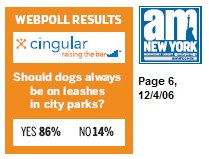
The daily weekday newspaper, AM NY, conducted a poll of New York City residents from Friday, December 1st to Sunday December 3rd. The question came on the heels of the court ruling granting the Parks Commissioner the authority to designate off-leash areas outside of dog runs, and just before the Department of Health rules on whether or not to allow the Parks Commissioner to relax the leash law in city parks. The current health code states that dogs must be leashed in all public areas which include city parks.
The result of the poll comes as no surprise to the Juniper Park Civic Association. For months, the off-leash crowd has been ridiculously suggesting that JPCA is a small group of dog haters because we do not want to see dogs run loose in city parks. However, this poll proves that there are a lot more people out there that feel the same way, and we are sure the vast majority of them harbor no hatred toward dogs. They are just concerned with the safety of people.
More than 1700 votes were cast, and out of those, more than 1500 people voted "yes" while just over 200 voted "no" to the question of, "Should dogs always be on leashes in city parks?"
Will NYC Health Commissioner Thomas Frieden and company cater to the off-leash fringe and vote in opposition to the majority of New York City residents that they are sworn to protect? Tune in tomorrow, when the Board of Health makes its vote on the matter.
Friday, December 01, 2006
A note to the lunatic fringe off-leashers
Be careful what you wish for.
"The court is keenly aware that while it can dispose of the legal issue presented, the broad emotional effect of the issues raised will remain. In the face of the angst and vitriol exhibited herein, common sense would dictate that something more than an "unwritten policy" governing the off-leash use of parkland by dogs, which is known by few and misunderstood by many, is required in this instance.
With this in mind, the statement by the respondent's counsel during oral argument, as amplified in writing, that respondent's will formalize the details of the current off-leash policy within the Park Rules, is, hopefully, more than mere puffery.
The alternative is simply more endless litigation over what is, inherently, an administrative and political problem."
The above qoute is an excerpt from Judge Kelly's ruling that the commissioner of parks does have the authority to allow people to run their dogs unleashed in city parks. At least now this will force the department of parks to formalize their "unwritten" rule changes under the procedures required by CAPA. I believe a lot more voices will be heard this time around.
"The court is keenly aware that while it can dispose of the legal issue presented, the broad emotional effect of the issues raised will remain. In the face of the angst and vitriol exhibited herein, common sense would dictate that something more than an "unwritten policy" governing the off-leash use of parkland by dogs, which is known by few and misunderstood by many, is required in this instance.
With this in mind, the statement by the respondent's counsel during oral argument, as amplified in writing, that respondent's will formalize the details of the current off-leash policy within the Park Rules, is, hopefully, more than mere puffery.
The alternative is simply more endless litigation over what is, inherently, an administrative and political problem."
The above qoute is an excerpt from Judge Kelly's ruling that the commissioner of parks does have the authority to allow people to run their dogs unleashed in city parks. At least now this will force the department of parks to formalize their "unwritten" rule changes under the procedures required by CAPA. I believe a lot more voices will be heard this time around.
Subscribe to:
Posts (Atom)
